
If your basement has ever taken on water during a Maryland thunderstorm, you already know which factors you depend on a working sump pump. If you’re researching sump pump replacement in Gaithersburg, MD, the timing matters. Spring and early summer bring the year’s heaviest rains, and a pump that’s silently failed since November is the most common cause of a flooded basement in May. This guide walks through how sump pumps work, the warning signs of a failing unit, and how Mallick Plumbing & Heating handles replacement for Gaithersburg and Montgomery County homes.
How a Sump Pump Works
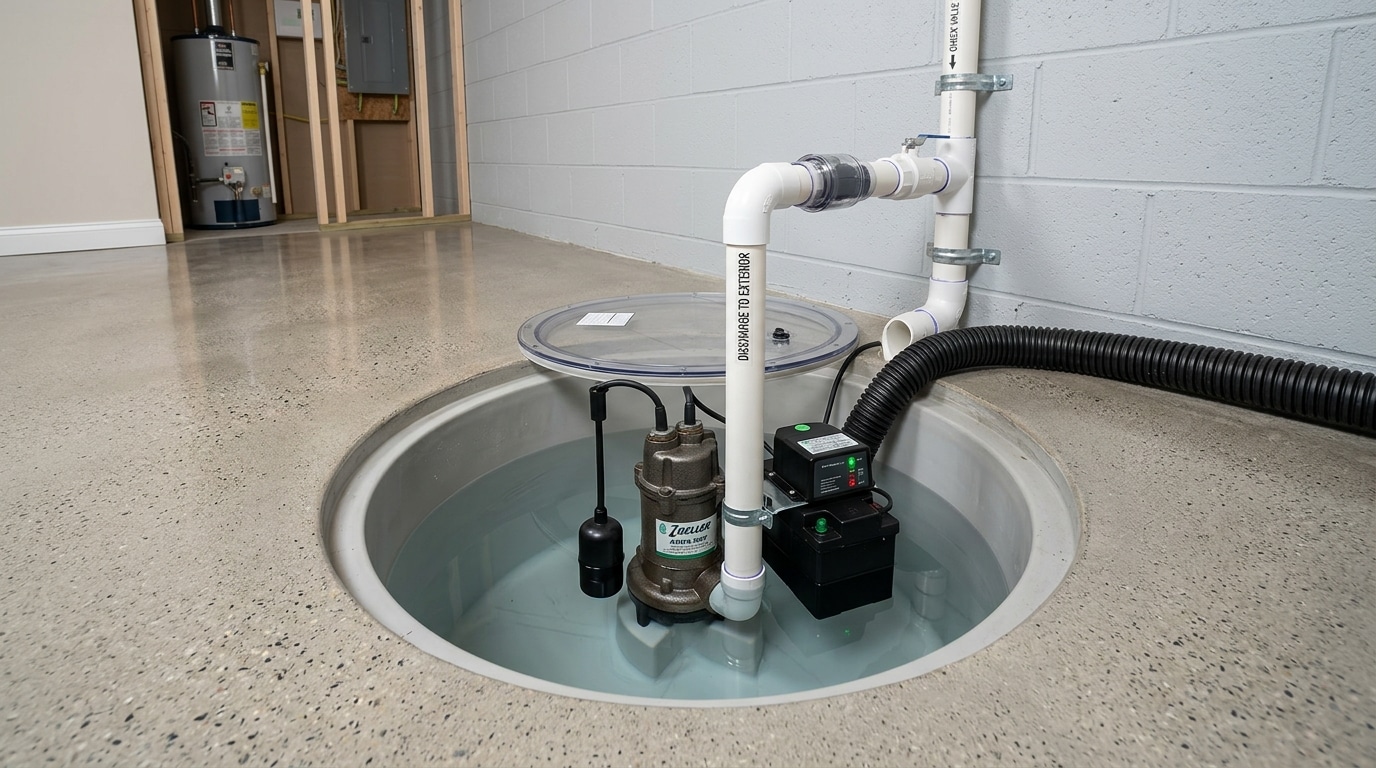
A sump pump sits in a pit dug into the lowest point of your basement floor. Groundwater that would otherwise seep through your foundation collects in the pit. When the water level rises high enough to trigger the float switch, the pump activates and discharges the water through a pipe that runs outside, well away from the foundation. Most Gaithersburg homes have a primary pump that runs on household electric power and, in some homes, a battery-backup pump that takes over during a power outage.
The pump runs on demand. If groundwater is low, you may not hear it run for weeks. After heavy rainfall, it can cycle every few minutes for hours. Both are normal. What’s not normal is the silence after a storm when the pit is filling. That’s the failure mode that impacts homeowners the most.
7 Signs Your Sump Pump Is Failing
Most failing pumps give warning signs in the weeks before they quit entirely. Watch for these:
- Strange noises. Grinding, rattling, or a humming sound that doesn’t end with water moving is a sign the impeller is jammed or the motor is dying.
- Constant running. If the pump cycles non-stop even when the pit looks empty, the float switch is stuck or the check valve has failed and water is flowing back into the pit.
- It runs but doesn’t pump. The motor hums but the water level doesn’t drop — usually a jammed impeller or a frozen / blocked discharge pipe.
- Visible rust on the housing. Surface rust accelerates fast once it starts. By the time it’s visible, internal corrosion is already affecting the motor bearings.
- Pump is more than 7 to 10 years old. Residential sump pumps have a finite service life. Past a decade, the question isn’t if it will fail, it’s when.
- It tripped a breaker. A pump pulling too much current is a pump on its way out.
- The pit smells. A musty or sewer-like smell usually means standing water has been sitting too long — the pump isn’t keeping up.
Why Maryland Storms Are Hard on Sump Pumps
Gaithersburg and the broader Montgomery County area sit in a climate zone that delivers heavy convective thunderstorms from late spring through early fall. The National Weather Service Baltimore/Washington office tracks regular events of 1 to 3 inches of rain in a single afternoon during this stretch. A storm that intense pushes a residential sump pump to its limit — cycling every minute or two for hours.
The freeze-thaw cycle of Maryland winters is also harder on pumps than most homeowners realize. Discharge lines that freeze solid in January can crack, and the pump runs without actually moving water out of the pit when the spring thaw arrives.
Repair vs. Replace
Some sump pump issues are simple repairs. A jammed impeller can sometimes be cleared. A failed check valve is a straightforward swap. A stuck float switch can occasionally be replaced as a single part. But for older pumps, repair is rarely worth doing. Once the motor itself starts failing, full replacement is the practical answer. A Mallick technician can diagnose the issue and tell you honestly which category you’re in.
Choosing the Right Replacement Pump
Three decisions shape every sump pump replacement in Gaithersburg:
- Pedestal vs. submersible. Submersible pumps sit in the water and run quieter, with longer lifespans. Pedestal pumps sit above the water with a motor on a stalk — cheaper, but louder and shorter-lived. Submersible is the right call for most Maryland homes.
- Cast iron vs. plastic housing. Cast iron dissipates heat better than plastic, which extends motor life. For homes where the pump runs often, the upgrade is worth it.
- Battery backup. Maryland’s biggest storms also tend to knock out power. A pump that quits the moment your power does is a pump that lets the basement flood. We recommend a battery-backup system on every replacement in a finished basement.
For homes that have flooded once already, a battery backup combined with a Wi-Fi alarm that pings your phone when water is detected is the most impact-effective insurance policy in residential plumbing.
Battery Backup: The Single Best Upgrade
If you take only one thing from this guide, take this: a battery backup pump is the single most impact-effective upgrade most Gaithersburg basements can make. Maryland’s biggest storms tend to knock out residential power just as the sump pit is filling fastest. A primary pump that depends on household current is useless during the exact 30-minute window that determines whether your basement floods.
A modern battery backup system installs alongside the primary pump and engages automatically when household power fails or the primary pump can’t keep up. The battery is maintenance-free for several years and recharges from your electrical panel between events. Most systems include an audible alarm that activates when the backup takes over, so you know to investigate before the next outage.
For finished basements — where flooding means ruined drywall, flooring, and personal belongings — we recommend a battery backup on every install. For unfinished basements with concrete floors, the calculation is more about protecting belongings stored at floor level than the basement itself. Either way, Gaithersburg’s storm history makes the case for backup nearly every season.
Why Gaithersburg Homeowners Choose Mallick Plumbing
Mallick Plumbing & Heating has been installing and servicing sump pumps in Gaithersburg, Rockville, Germantown, Bethesda, and the rest of Montgomery County for years. Every replacement starts with a written, itemized quote. We size the pump to your home’s actual water-table conditions, install a battery backup when appropriate, and test the full system before we leave. Our 24/7 emergency line means you have someone to call if a pump fails during a storm.
For more on the sump pump services we offer across Frederick County and Montgomery County, visit our sump pump services page.
Schedule a Sump Pump Inspection Before Storm Season
The best time to discover a failing sump pump is on a dry afternoon, not at 2 a.m. during a thunderstorm. A Mallick technician can test your pump, check the discharge line, verify the battery backup if you have one, and replace it if needed before the next big storm hits. Schedule a sump pump inspection with Mallick Plumbing & Heating today.