
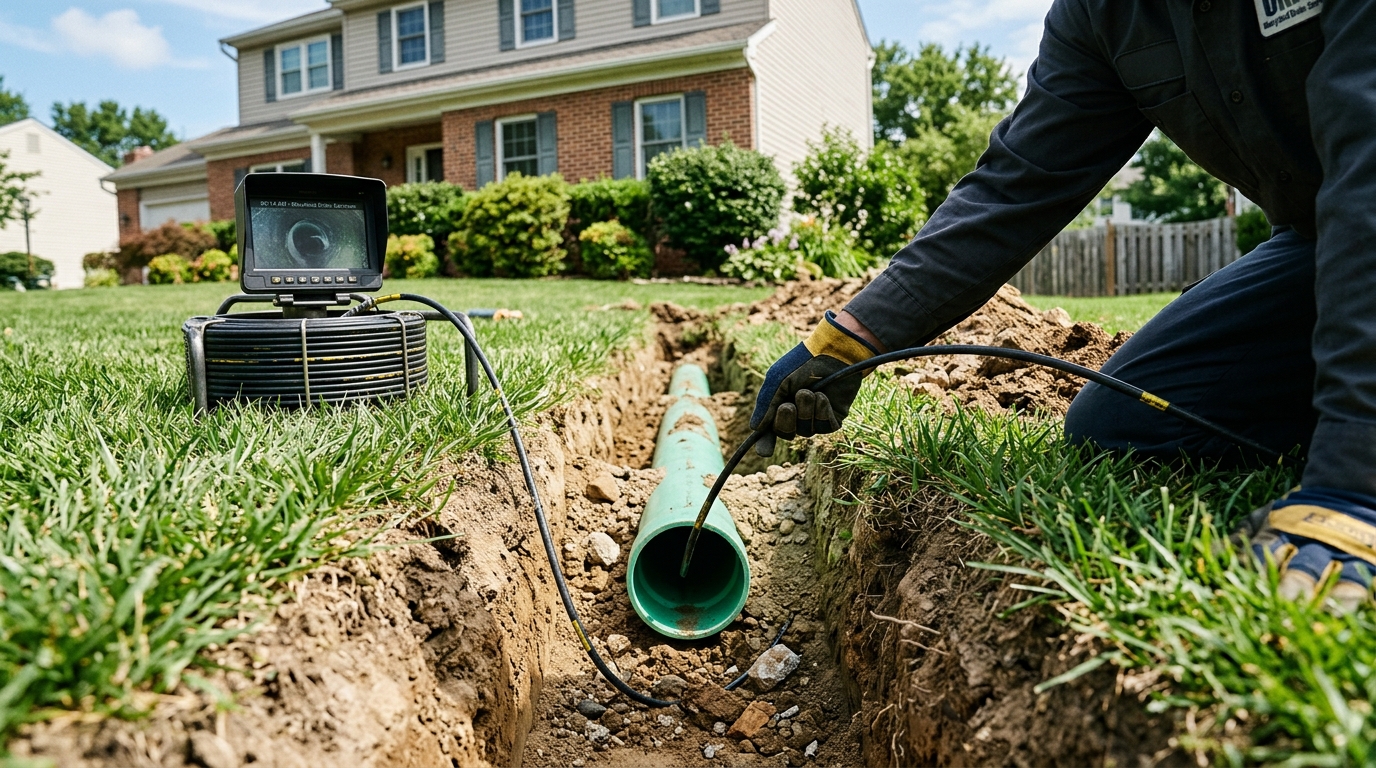
Of all the plumbing problems a Maryland homeowner can have, a failing sewer line is the most disruptive. The symptoms come on slowly, the repair is invasive, and ignoring it eventually leaves you with sewage backing up into the lowest fixtures in the house. If you’re researching sewer line repair in Maryland because you’ve noticed a slow drain in the basement or a soggy patch in the yard, this guide walks through the signs, the causes, and what to expect when a licensed plumber from Mallick Plumbing & Heating diagnoses and fixes the problem.
6 Signs of a Sewer Line Problem
Sewer line failures rarely happen all at once. Watch for these indicators:
- Multiple drains slow or gurgle at the same time. A clogged kitchen sink alone is usually a localized blockage. When the toilet, the tub, and the basement floor drain all start acting up together, the problem is in the main line.
- Sewage smell inside or in the yard. The smell of sewage in the basement, or coming up from a floor drain, points to a sewer line that’s no longer venting properly. A wet, sewer-smelling patch in the yard often means the line has broken underground.
- Unusually green grass in a line over the sewer. A leaking sewer line acts as fertilizer. A stripe of greener, taller grass running from the house to the street is a classic warning sign.
- Wet spots in the yard with no obvious cause. Soft, soggy patches that don’t dry out after rain stops can be sewer line leaks.
- Backups in the lowest fixture. If a basement floor drain or basement toilet backs up when you flush an upstairs toilet, the main line is partially blocked downstream.
- Foundation cracks or settling. A long-running underground leak can wash soil away from your foundation, causing localized settling and cracking.
If any of these show up, stop using water in the house and call us. A sewer backup that continues to grow gets exponentially harder to clean up.
Top Causes of Sewer Line Problems in Maryland Homes
Maryland’s housing stock and soil conditions create a specific set of failure modes. The most common causes we see in Gaithersburg, Montgomery County, and Frederick County:
- Tree root intrusion. Older mature trees in established Maryland neighborhoods send roots toward any moisture source. Sewer lines with even small cracks attract roots, which then grow inside the pipe and create blockages. This is by far the most common cause we see in homes built before 1990.
- Aging clay or cast iron pipe. Many Maryland homes built before 1980 have clay or cast iron sewer laterals. EPA infrastructure studies note that these materials have finite lifespans and tend to fail after 50 to 80 years, depending on soil conditions.
- Bellies and sags. Over decades, ground movement can cause a section of sewer line to sag below grade. Waste collects in the low spot and creates chronic clogs even though the pipe itself isn’t broken.
- Corroded cast iron from the inside. Cast iron sewer pipe corrodes from the inside over decades. The bore narrows, then scale flakes off and creates blockages.
- Joint separation. Older sewer lines were laid in segments. Ground shifting can pull the joints apart, allowing roots in and waste out.
- What gets flushed. “Flushable” wipes, paper towels, feminine products, and grease build up in sewer lines and accelerate every other failure mode.
How a Sewer Camera Inspection Works
The diagnostic step that separates a guess from a real plan is a sewer camera inspection. A flexible cable with a high-resolution camera on the tip is fed into the sewer line through an access point, usually a basement cleanout. The camera shows real-time video of the entire run from the house to the street main, capturing exactly where the problem is, what’s causing it, and how severe it is.
A camera inspection takes a Mallick technician 30 to 60 minutes and tells you with certainty whether you’re dealing with a single tree-root blockage, a belly in the line, a full pipe failure, or something else entirely. Without one, you’re guessing — and guessing wrong on a sewer line repair gets expensive fast.
Repair vs. Full Replacement
The camera tells us which path makes sense. The two main repair options for Maryland homes are:
- Spot repair / cleanout. For localized issues — a single tree-root intrusion, a specific clogged section, a single broken joint — a spot dig or hydro-jetting can clear the issue without replacing the entire line.
- Trenchless replacement (pipe lining or pipe bursting). For older lines with multiple failure points, a lining system installs a new pipe inside the old one with minimal digging. Pipe bursting pulls a new pipe through the old line, fracturing the old one as it goes. Both options preserve landscaping and driveways compared to traditional excavation.
- Open-trench replacement. When the line is too far gone or in a layout that doesn’t suit trenchless methods, traditional excavation is still the right answer. It’s the most disruptive but the most thorough fix.
The Repair Process Step by Step
When you call Mallick Plumbing for a suspected sewer line issue, here’s what to expect:
- Diagnostic visit. A licensed Maryland plumber arrives, talks through the symptoms, and runs a sewer camera inspection.
- Written, itemized estimate. Based on what the camera shows, we provide a written quote with the recommended approach and any alternative options.
- Permit coordination. Montgomery County and Frederick County require permits for sewer line work that involves the property line or county right-of-way. We pull all required permits and coordinate inspections.
- Repair. Most spot repairs are completed in a single day. Trenchless replacements typically take one to two days. Open-trench replacements depend on length and depth.
- Final inspection and cleanup. We run a follow-up camera inspection on the new line and restore any disturbed yard or hardscape to the extent the contract specifies.
Why Mallick for Sewer Line Work in Maryland
Mallick Plumbing & Heating has been handling sewer line repairs and replacements in Gaithersburg, Rockville, Germantown, Bethesda, Frederick, Woodbine, and the surrounding communities for years. Every job starts with a real diagnostic — not a guess. We pull every required permit, document the work with before-and-after camera footage, and back our work with a written workmanship warranty. For active backups, our 24/7 emergency line is staffed by live dispatchers, not voicemail.
For more on the sewer services we provide for Maryland homes, visit our sewer services page.
Get a Sewer Line Inspection in Maryland
The most basic sewer repair is the one you catch before it becomes an emergency. If you’ve noticed any of the warning signs above, schedule a camera inspection before the line backs up. Schedule a sewer line camera inspection with Mallick Plumbing & Heating today.