
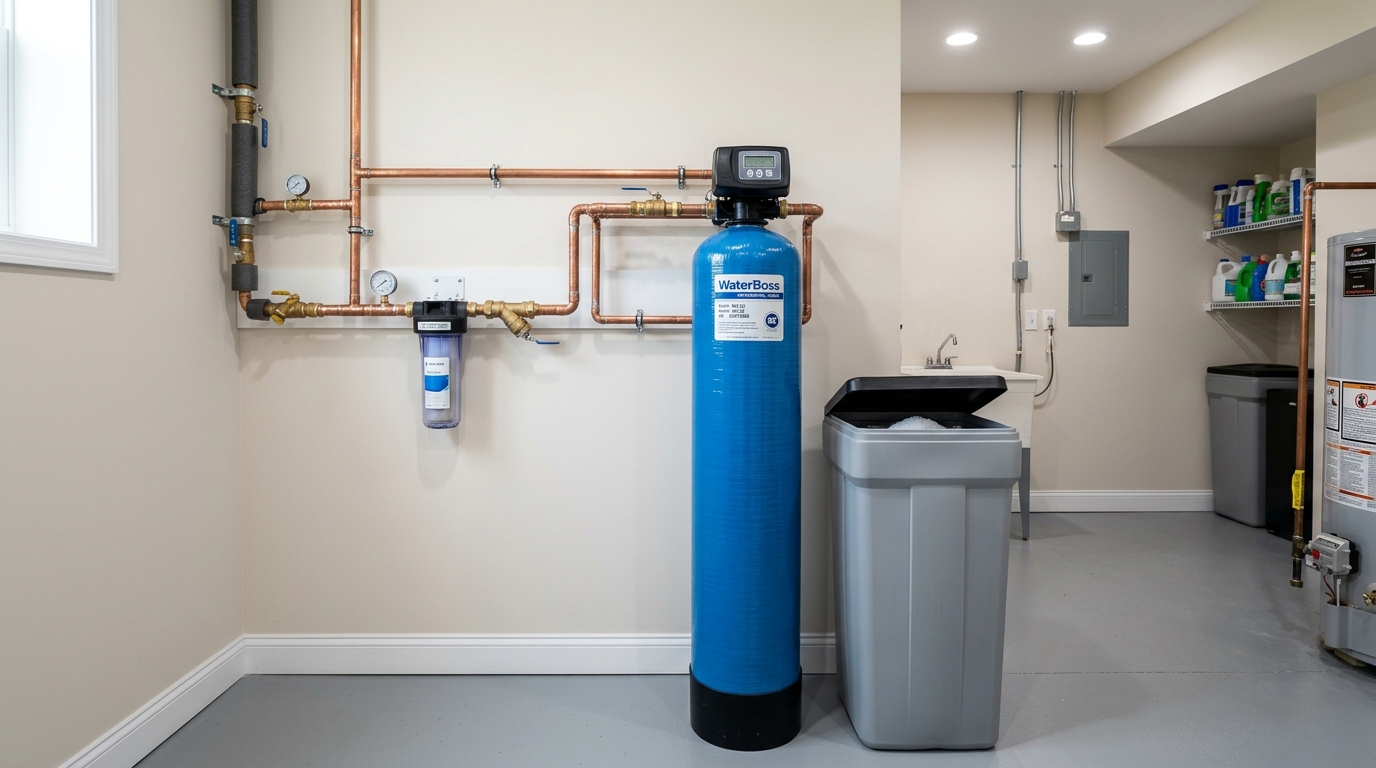
If you’ve ever fought white scale on the inside of a kettle, dingy laundry that won’t come clean, or a water heater that died years before it should have, you’ve already met Maryland’s hard water. The fix is a water softener in Frederick, MD, and choosing the right one matters more than most homeowners realize. This buying guide walks through how Frederick County’s water actually compares to other parts of Maryland, how a softener works, the main system types, and how Mallick Plumbing & Heating handles installation across Frederick, Woodbine, and the surrounding well-water communities.
How Hard Is Frederick County’s Water?
Water hardness is measured in grains per gallon (gpg) or parts per million (ppm). The USGS classifies water above 7 gpg (around 120 ppm) as hard, and Frederick County’s water — especially in homes on private wells — frequently tests at or above that mark.
Homes on municipal water in the city of Frederick typically see moderately hard water, similar to what Gaithersburg sees on WSSC. Homes outside the city limits on private wells see a much wider range. We’ve tested wells in Woodbine, Mount Airy, and rural Frederick County that came in at 15 to 25 gpg — well into the “very hard” category — with iron and manganese on top.
The practical effects of hard water in a Frederick County home are not subtle:
- White scale buildup on faucets, glass shower doors, kettles, and inside dishwashers
- Soap and detergent that don’t lather properly, leaving residue on skin, hair, and laundry
- Dingy white laundry that gets dingier with each wash
- Water heaters that run hotter, longer, and fail earlier than they should
- Pipes and appliances that develop interior scale that restricts flow
How a Water Softener Works
A water softener uses ion exchange. The system has a tank filled with small resin beads coated in sodium ions. When hard water passes through the tank, the calcium and magnesium ions in the water swap places with the sodium ions on the beads. The water leaves the tank “soft” — meaning the minerals that cause scale and dingy laundry are gone.
Periodically, the system regenerates. It pulls a brine solution (salt and water) from a second tank, flushes the resin beads to strip off the calcium and magnesium, then resets the beads with fresh sodium ions. This is why a softener needs a fresh bag of salt at regular intervals.
Salt-Based vs. Salt-Free Systems
The “salt-free water softener” you may have seen advertised is technically a water conditioner, not a softener. It doesn’t remove calcium or magnesium — it changes the mineral structure so it doesn’t bind to surfaces as readily. For homes with very mild hardness, these systems can help with scale but don’t deliver the laundry, skin, and hair benefits of a true softener.
For most Frederick County homes — especially on well water — a traditional salt-based softener is the right call. The math is simple: if your water is truly hard, you need actual ion exchange. A salt-free conditioner won’t move the needle on a 20-gpg well.
Sizing the System for Your Home
A correctly sized softener regenerates often enough to keep up with your household’s water use without wasting salt by regenerating more than it needs to. Three factors determine size:
- Daily water use. The average Frederick County household of four uses 250 to 400 gallons per day. Larger families and homes with luxury bathroom fixtures use more.
- Hardness level. A 25-gpg well needs a system with much more capacity than a 10-gpg one for the same household size.
- Regeneration cycle. Most modern softeners use demand-initiated regeneration — they regenerate when they’ve used a set volume of water, not on a fixed clock. This minimizes salt waste.
We never install a softener without an on-site water test first. Sizing the system before knowing what’s in the water is how homeowners end up with a unit that’s too small or one that regenerates wastefully.
Maintenance and Salt Refill Schedule
A residential softener needs minimal day-to-day attention but a regular maintenance rhythm:
- Salt refill: A 40 to 50 pound bag of salt every 4 to 8 weeks for a typical Frederick household, depending on water use and hardness. We recommend topping up before the brine tank drops below half.
- Salt bridging: Salt can occasionally form a crust that prevents new salt from dissolving. A quick break-up with a broom handle every few months prevents this.
- Resin bed: Lasts many years before needing replacement. Hard water with high iron content shortens resin life — a sediment pre-filter extends it.
- Annual inspection: A 20-minute checkup confirms the regeneration cycle is firing correctly, the brine line is clear, and the bypass valve still functions.
Mallick’s Installation Process
A typical Mallick Plumbing & Heating softener install in Frederick County looks like this:
- On-site water test. We sample the incoming water and run a full hardness, iron, and pH panel. The result tells us exactly what system you need.
- Written quote. Itemized, fixed service scope for equipment and labor. No surprise service requirements.
- Installation. Most softeners are installed in a half day. We tie the system into the main water line near where it enters the house, ahead of the water heater so all hot and cold water in the home is softened.
- System startup. We charge the resin, run the first regeneration cycle, and verify softness at multiple fixtures.
- Walkthrough. We show you how to refill the salt, where the bypass valve is, and what the regeneration schedule will look like.
For homes that already had a softener installed by Mallick or another provider, see our companion piece on water softener installation in Frederick, MD.
Why Frederick County Homeowners Choose Mallick
Mallick Plumbing & Heating has been installing water softeners across Frederick, Woodbine, Mount Airy, and the surrounding communities for years. We test water before recommending equipment, install from established brands with Maryland service networks, register the manufacturer warranty in your name, and offer maintenance plans so the salt schedule is on someone’s calendar besides yours. For our broader water-treatment lineup, visit our Frederick water filtration services page.
Get a Free Water Hardness Test
The fastest way to find out what your water actually needs is to know what’s in it. Schedule a water hardness test with Mallick Plumbing & Heating and we’ll come out, run the panel, and walk you through your options. No pressure, no boilerplate quote.