Acid Neutralizer Tank Guide for Poolesville, MD Well Owners

Blue-green stains in the sink, a metallic taste in the morning glass, and a pinhole leak in a copper line that is barely a decade old. Those three symptoms point to the same cause: the well water in your house is acidic, and it is dissolving your plumbing from the inside.

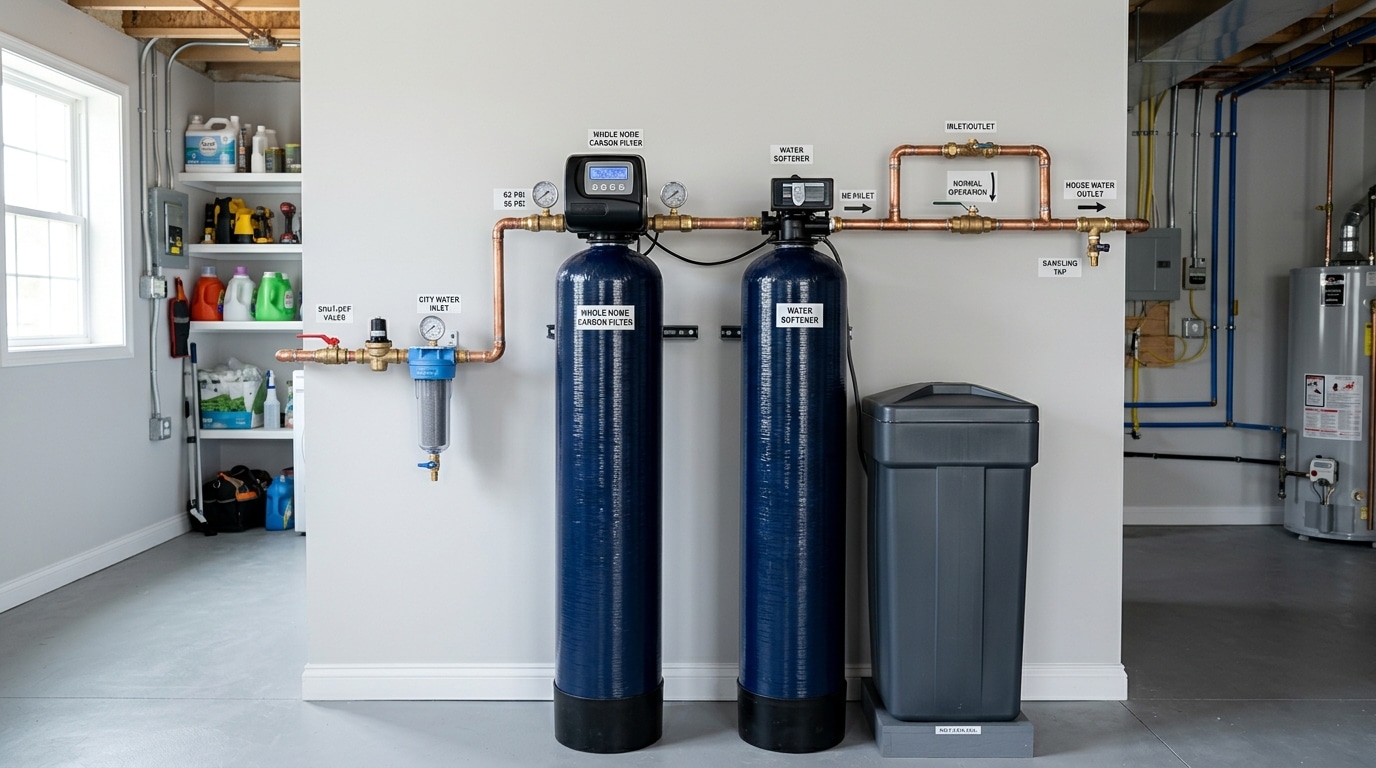
An acid neutralizer tank is the standard fix. It raises the pH of incoming water before that water ever reaches a copper joint. For homes around Poolesville that draw from a private well, it is one of the few pieces of equipment that protects the copper inside your walls.

Why Well Water Turns Acidic in the First Place

Rain falls slightly acidic and picks up more carbon dioxide as it filters through soil and decaying leaf litter. That dissolved carbon dioxide becomes carbonic acid in the groundwater.

Where an aquifer sits in limestone, the rock neutralizes that acid and the water comes up hard and alkaline. Where the bedrock is granite, gneiss, or sandstone with little carbonate to donate, nothing buffers the acid and the well delivers low-pH water to the house.

Low-pH water is hungry. It pulls copper out of the pipe wall, which is why the stains are blue-green and the leaks appear as pinholes rather than splits. The USGS water science school explains how water chemistry changes as it moves through different rock.

How an Acid Neutralizer Tank Corrects pH

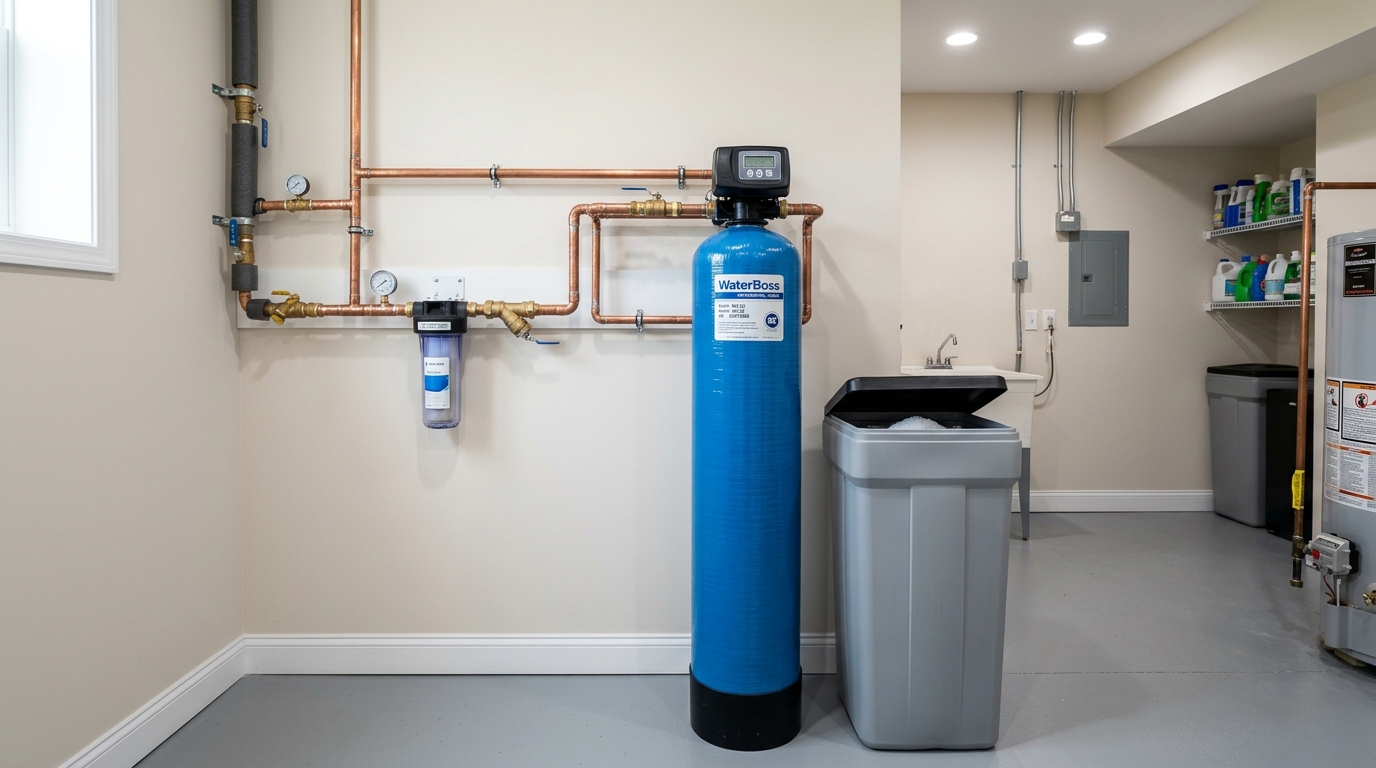
The tank looks like a softener without a salt bin. Inside is a bed of calcite, which is crushed limestone, or calcium carbonate in its mineral form.

As acidic water percolates down through the media, it dissolves a small amount of that calcite. The carbonate goes into solution, neutralizes the acid it meets, and the water leaves the acid neutralizer tank at a pH your copper and brass can live with. Some systems blend in magnesium oxide for water that is strongly acidic, because it dissolves faster and lifts pH further.

Notice the trade-off in that description. The media is sacrificial. Every gallon treated consumes a little limestone, so the bed shrinks over time and the tank needs recharging with new calcite.

Why an Acid Neutralizer Tank Stops Working

An untouched neutralizer eventually fails quietly, and homeowners rarely notice until the fixtures stain again.

The Media Runs Out

This is the usual cause. The calcite dissolves away until the remaining bed is too shallow for water to contact long enough, and pH correction fades. Topping up the media is routine service on an acid neutralizer tank.

The Bed Cements Together

Fine calcite particles and dissolved minerals can bind the media into a crust. Water then channels through cracks instead of soaking through the whole bed.

A working backwash cycle fluffs and rinses the media to prevent exactly this. A stuck control valve or a backwash set too short will let the bed solidify.

Iron and Sediment Coat the Grains

Well water carrying iron or silt coats the calcite surface. Buried limestone cannot dissolve, so the acid neutralizer tank passes water through without correcting much of anything.

Warning Signs in a Home With Acidic Water

  • Blue-green stains in sinks, tubs, and shower pans, or on fixture trim.
  • Pinhole leaks in copper supply lines, often several within a few years.
  • A metallic or bitter taste, strongest in water that sat overnight.
  • Corroded brass fittings and quickly failing water heater components.
  • Rising hardness or scale after a neutralizer has been in service a while.

What This Looks Like in a Poolesville Home

Picture a Poolesville homeowner facing a second pinhole leak in a basement copper line in under two years. The first was patched and forgotten, and the second drips onto a finished ceiling.

In a case like this, a water test will often show pH well into the acidic range. Say the neutralizer in the utility room was installed by a previous owner and never serviced. A likely finding is a media bed that has dropped to a few inches, with the top crusted solid. The fix is typically a media recharge, corrected backwash settings, and a re-test of the treated line, which gives the copper a fighting chance.

Neutralizer, Softener, or Both?

These units solve opposite problems, and the order matters in a Maryland well system:

  • The neutralizer raises pH so the water stops dissolving copper and brass.
  • A softener removes hardness so scale stops forming in the water heater and fixtures.
  • Calcite adds hardness as a side effect, which is why a softener usually belongs downstream of the neutralizer.
  • A sediment filter belongs upstream so silt and iron never reach the media.

Our neutralizer service page explains how we size and stage these units, and water testing confirms which of them your well actually needs.

Service Steps We Follow

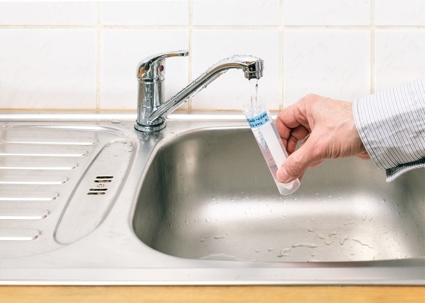
  1. Test pH, hardness, iron, and total dissolved solids on the raw well line.
  2. Open the tank and measure how much media is left in the bed.
  3. Check the backwash cycle, the flow control, and the drain line.
  4. Recharge the media and, where needed, blend in a faster-acting mineral.
  5. Re-test the treated line so you can see the pH shift in numbers.

If your fixtures are staining again, call and schedule a neutralizer check before the next pinhole leak finds a finished ceiling.

Safety Notes and When to Call a Plumber

A tank full of calcite is far heavier than it looks, so never wrestle one alone or on a wet floor. Depressurize and isolate the unit before opening the head, and keep media out of your eyes when you pour.

Call a plumber when you see a second pinhole leak, when stains return after service, or when treated water still tests acidic. Because EPA private well guidance puts testing responsibility on the homeowner, ask your doctor about drinking water if anyone in the house has a health condition affected by metals in water.

Frequently Asked Questions

How often does calcite media need topping up?

It depends on how acidic the water is and how much the household uses, so heavy use with very low pH consumes media quickly. Most homes have the bed checked annually and recharged when it falls below the level the unit needs.

Will an acid neutralizer tank make my water hard?

It raises calcium content, which is how it works. Homes that were already near the hardness threshold often add a softener after the neutralizer to keep scale off the water heater.

Can acidic water damage pipes other than copper?

Yes. Low pH attacks brass fittings, galvanized steel, and the components inside a water heater. Plastic piping resists it, which is why some homes end up repiping, as our piping services page describes.

How do I know if my well water is acidic?

A laboratory water test is the only reliable answer, since pH cannot be seen or tasted with confidence. University of Maryland Extension publishes guidance on what Maryland well owners should test for.

Your Next Step in Poolesville

Acidic water is a slow problem that gets worse with every gallon you run. Call Mallick Plumbing & Heating to schedule an acid neutralizer tank inspection in Poolesville, and we will test the water, measure the media bed, and set the system to protect your copper.
UV Water Purifier Maintenance for Woodbine, MD Well Owners

The blue light in the basement is still on, so the system must be working. That assumption is the most common mistake we see with ultraviolet treatment. A UV water purifier can glow brightly for months after it has stopped killing anything in the water.

If your home in Woodbine draws from a private well, the UV chamber is the last line of defense between the aquifer and your kitchen tap. This article explains how that chamber disinfects, why it quietly loses power, and what maintenance actually keeps it effective.

How a UV Water Purifier Disinfects Well Water

Inside the stainless steel chamber is a lamp that emits a narrow band of ultraviolet energy known as UV-C. Water flows through the thin annular space between the chamber wall and the lamp, so every drop passes within a short distance of the light.

UV-C energy does not filter, heat, or chemically treat the water. It penetrates the cell wall of bacteria, viruses, and protozoa and scrambles their DNA and RNA. The organism is still physically present, but it can no longer reproduce, which is what makes it harmless to drink.

The lamp never touches the water. It sits inside a quartz sleeve, a clear tube that keeps the lamp dry while letting UV-C pass through. That sleeve is where most failures begin, and it is the part homeowners almost never think about.

Why a UV Water Purifier Fails While the Lamp Still Glows

Three separate failures produce the same false sense of security.

The Quartz Sleeve Clouds Over

Well water in this part of Maryland carries dissolved hardness minerals, iron, and manganese. As water passes the warm sleeve, those minerals plate onto the quartz as a thin film.

Glass that looks only slightly hazy can block a large share of the UV-C energy reaching the water. The lamp is still burning, the light still looks blue, and the dose arriving at the organisms has collapsed. Cleaning or replacing the sleeve is the core of UV water purifier maintenance.

The Lamp Solarizes

UV lamps do not burn out the way a bulb does. Their output declines steadily as the quartz envelope darkens under its own radiation, a process called solarization.

By the end of its rated service life, a lamp still produces visible light with far less of the germicidal energy it started with. That is why manufacturers specify annual lamp replacement on a calendar rather than waiting for a failure.

Sediment Shadows the Organisms

UV-C travels in straight lines. A speck of silt, a rust flake, or cloudy water gives a bacterium somewhere to hide, and anything in that shadow passes through untreated.

Every UV system needs a sediment prefilter matched to the water it treats. Skip it and even a perfect lamp will not deliver a reliable dose.

Signs Your UV System Needs Attention

A Woodbine Well Scenario

Picture a Woodbine family whose routine well test comes back positive for coliform. Their UV system is running, the display is lit, and nothing looks wrong in the utility room.

Say the lamp has been in place for several years. In a case like this, the quartz sleeve is likely to come out coated with a rust-orange film from iron in the well water. Between an aged lamp and a fouled sleeve, the water may be getting a fraction of the dose it needs. The fix is typically a new lamp, a cleaned sleeve, a fresh prefilter, and a system disinfection, followed by a retest of the water.

What UV Does and Does Not Handle

Ultraviolet treatment is precise about its job, and that precision cuts both ways:

The EPA private well guidance recommends regular testing for total coliform bacteria and nitrate, because a well owner is their own water utility. Penn State Extension publishes detailed material on interpreting those results.

A Practical Maintenance Schedule

  1. Replace the lamp on the manufacturer’s annual schedule, even if it still lights.
  2. Pull and clean the quartz sleeve at the same visit, and replace it if scale will not come off.
  3. Change sediment and carbon prefilters before they restrict flow.
  4. Test the well water at least annually, and again after any plumbing work.
  5. Disinfect the system after a power outage, a repair, or a positive test.

If your lamp is overdue, schedule service through our UV water purifier page and pair it with water testing so the result confirms the repair worked.

Safety Notes and When to Call a Plumber

Never look at an energized UV lamp. UV-C burns eyes and skin quickly, so always unplug the controller before opening the chamber. Lamps contain mercury and the quartz is fragile, so handle both carefully and follow local disposal rules.

Call a plumber when a test comes back positive, when the controller alarms, or when the sleeve will not come clean. If a household member is pregnant, an infant, or immune-compromised, use a safe alternate water source and ask their doctor for guidance until a follow-up test is clear.

Frequently Asked Questions

How often does a UV lamp need to be replaced?

Once a year is the standard manufacturer interval for residential units. Output fades long before the lamp goes dark, so replacement is scheduled by time in service rather than by appearance.

Can I clean the quartz sleeve myself?

Many well owners do, using the cleaning solution the manufacturer specifies. Cut power first, handle the quartz gently, and replace the O-rings when you reassemble. Persistent staining means the sleeve should be replaced.

Do I still need a filter with a UV water purifier?

Yes. Sediment shields organisms from the light, and hardness or iron will foul the sleeve within months. University of Maryland Extension offers background on common well water problems in this region.

What happens during a power outage?

The lamp goes out and untreated water moves through the chamber. After power returns, run the system, replace prefilters if needed, and disinfect the plumbing before returning to normal use.

Your Next Step in Woodbine

Ultraviolet disinfection works extremely well when it is maintained and not at all when it is ignored. Call Mallick Plumbing & Heating to schedule UV water purifier service for your Woodbine home, and we will replace the lamp, service the sleeve and prefilters, and test the water to confirm the results.

Reverse Osmosis Membrane Problems in Potomac, MD Homes

The drinking water faucet used to fill a glass in seconds. Now it dribbles, quits halfway, and the water tastes like the tap again. In almost every case, the reverse osmosis membrane is either blinded by mineral scale or starved of the pressure it needs to work.

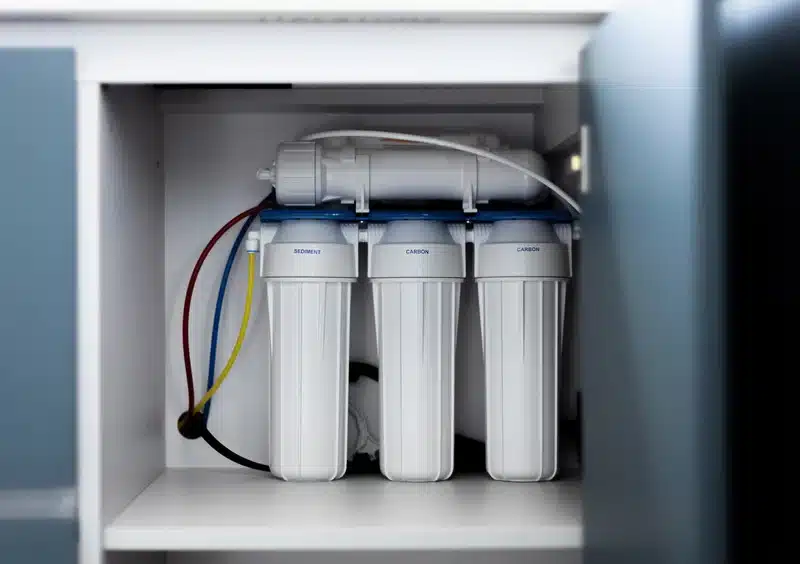
A reverse osmosis membrane is not a screen and it does not clog like a filter. It is a rolled sheet of polymer film that separates water molecules from everything dissolved in them. Once you understand that difference, the symptoms at the faucet start making sense.

How a Reverse Osmosis Membrane Actually Makes Drinking Water

Inside the horizontal housing under your sink sits a tightly wound spiral of thin-film composite material. The active layer is a polyamide skin, and it is dense enough that dissolved salts, metals, and nitrates cannot pass through it.

House pressure pushes water against that skin. Pure water molecules squeeze through and collect as permeate, while the rejected minerals stay on the feed side and are washed to the drain as concentrate. That stream to the drain is not waste in the way people assume; it is what keeps the reverse osmosis membrane from burying itself in its own rejected minerals.

Permeate trickles out slowly, so it collects in a small storage tank with an air bladder. When you open the faucet, that bladder squeezes the stored water out. The EPA drinking water program describes the contaminants utilities monitor and report each year, which is a useful starting point for deciding what you want filtered.

Why a Reverse Osmosis Membrane Stops Producing

Four failures cover nearly every slow RO faucet we are called out to look at.

Hardness Scales the Film

Hard water concentrates on the feed side of the membrane as pure water leaves. Calcium and magnesium climb past their solubility limit right at the film surface and precipitate as crystal scale.

That scale is bonded mineral, not loose sediment, so flushing does not remove it. A scaled reverse osmosis membrane produces less and less permeate until the faucet gives you a trickle.

Chlorine Destroys the Polyamide Layer

Polyamide film has almost no tolerance for chlorine. The carbon prefilter exists to strip that disinfectant out before the water reaches the housing.

When the carbon prefilter is past its life, chlorine breaks the polyamide bonds and opens the film. Flow often improves at first, which fools people, but the water now tastes like the tap because the reverse osmosis membrane is no longer rejecting anything.

Sediment and Biofilm Foul the Surface

Silt, rust flakes, and pipe scale blind the inlet side. Bacteria then colonize the damp surfaces and build a slick biofilm, especially in a system that sits unused during a long vacation.

Feed Pressure Falls or the Tank Waterlogs

Reverse osmosis is a pressure-driven process, so anything that drops house pressure cuts production. A pressure reducing valve set low, a clogged sediment prefilter, or a storage tank that has lost its air charge all produce the same complaint. A waterlogged tank feels heavy and empty at the same time.

Signs Your RO System Needs Service

What This Looks Like in a Potomac Kitchen

Picture a Potomac homeowner who comes back from a summer away. Before the trip the RO faucet filled a pitcher without complaint. Now the same pitcher takes several minutes and the water smells stale.

In a case like this, the likely findings are prefilters left far past their change interval, a storage tank with almost no air charge, and a membrane housing sitting warm with standing water. The fix is typically new sediment and carbon prefilters, sanitized housings, a recharged bladder, and a new element.

Under-Sink RO or Whole-House Filtration?

These two answer different questions, and Potomac homes often end up with both:

Our reverse osmosis service page and our whole-house filtration options lay out how the stages fit together in one plumbing system.

The Maintenance Order That Keeps a Membrane Alive

  1. Replace the sediment prefilter on schedule so grit never reaches the film.
  2. Replace the carbon prefilter on schedule so chlorine never reaches the film.
  3. Check the storage tank air charge with the tank isolated and empty.
  4. Test the treated water so you know the element is still rejecting solids.
  5. Sanitize the housings whenever the system is opened or left idle for weeks.

Prefilters exist to protect the element sitting behind them. If yours are overdue, call and schedule a filter change before the membrane takes the damage instead.

Safety Notes and When to Call a Plumber

Shut off the feed valve and relieve pressure before opening any housing, because a pressurized canister can let go when the wrench turns. Sanitizing solutions must be handled by the label directions and flushed completely before anyone drinks the water.

Call a plumber when production stays slow after new prefilters, when you see water under the cabinet, or when the drain line runs without stopping. If anyone in the house has a health condition that depends on water quality, ask your doctor what to filter for and test before you buy equipment.

Frequently Asked Questions

How often should a reverse osmosis membrane be replaced?

It depends on feed water more than time. Hard, chlorinated, or sediment-heavy water shortens element life, while a softener and fresh prefilters extend it. A treated-water test tells you far more than the date on the sticker.

Why does my RO system send water down the drain?

The concentrate stream carries away the minerals the film rejected. Without it, those minerals would build up on the surface and choke production. The EPA WaterSense program has practical guidance on household water use if that flow concerns you.

Does an RO system remove hardness from the whole house?

No. It treats only the fixture it feeds. Hardness in your showers, dishwasher, and water heater needs a softener, which University of Maryland Extension covers in its home water quality material.

Can I install a replacement element myself?

Many homeowners can. The parts that catch people are sanitizing the housing, seating the O-rings correctly, and verifying tank pressure. If the system leaks or underproduces afterward, have it checked.

Your Next Step in Potomac

A slow drinking water faucet is a solvable problem, and the fix depends on which stage failed. Call Mallick Plumbing & Heating to schedule a reverse osmosis membrane inspection in Potomac, and we will test the treated water, check the tank charge, and service the stages in the right order. Start with water testing if you want the numbers first.

Water Softener Resin Bed Problems in Frederick, MD Homes

Your softener still runs a regeneration cycle every few nights, yet the shower door spots again and the soap refuses to lather. When that happens, the failure is almost always inside the tall tank. The water softener resin bed is the layer of small plastic beads that does the actual softening, and it wears out years before the control valve or the brine tank does.

Homeowners usually blame the salt first. In Frederick, what we find instead is a water softener resin bed that has been oxidized by disinfectant, coated with iron, or packed so tight that water runs around it rather than through it.

What a Water Softener Resin Bed Actually Does

Open the media tank and the contents look like wet amber sand. Each grain is a polystyrene bead, and the surface of every bead carries negatively charged sites holding loose sodium ions.

Hard water arrives loaded with dissolved calcium and magnesium. Those minerals hold a stronger positive charge than sodium, so when water filters down through the water softener resin bed, they seize the charged sites and push the sodium into the water instead. Plumbers call that trade ion exchange, and it is the entire reason a softener works.

Every bead has a fixed number of exchange sites, so the bed fills with hardness and stops trading. Regeneration reverses it. The control valve draws brine from the salt tank, floods the beads with concentrated sodium, and rinses the captured minerals to the drain. The USGS water science school explains how groundwater collects those minerals before they ever reach your house.

Why the Water Softener Resin Bed Breaks Down

Resin is tough, but nothing in a plumbing system lasts forever. Three failures account for nearly every dead bed we pull out of a tank.

Chlorine and Chloramine Oxidize the Beads

Municipal water arrives carrying a disinfectant residual, usually chlorine or chloramine. That residual is an oxidizer, and it slowly cuts the crosslinks that keep each bead rigid. The EPA drinking water program explains why utilities maintain a residual all the way to your meter.

As those crosslinks break, the beads swell, soften, and eventually smear into paste. A mushy water softener resin bed compacts under flow, restricts pressure, and sheds tan specks into faucet aerators and toilet fill valves.

Iron and Manganese Plate the Beads

Well water across this part of Maryland often carries dissolved iron and manganese. The moment that water meets air or an oxidizer, the iron converts to rust and plates itself across the bead surface.

The exchange sites are not used up in this case. They are buried. A fouled water softener resin bed turns rust-orange instead of amber, and it will keep running full regeneration cycles while softening almost nothing.

The Bed Channels Instead of Filtering

Media needs to sit loose enough to fluff during backwash. When resin compacts, or when the distributor tube screen at the bottom of the tank cracks, incoming water carves one narrow path and skips most of the media.

That shortcut is called channeling. The softener looks healthy, the salt drops on a believable schedule, and hard water sails past the water softener resin bed untreated.

Warning Signs Frederick Homeowners Notice First

Symptoms show up at the fixtures long before anyone opens the tank:

What This Looks Like in a Frederick Home

Picture a Frederick homeowner whose dishwasher starts leaving a chalky film on every glass a few years after a softener went in. The brine tank is full and the control valve is cycling on schedule, so the unit looks fine from the outside.

In a case like this, a technician would test hardness at an outside hose bib and again at a treated fixture. If the two numbers come back nearly identical, a likely finding inside the tank is a top few inches of media gone soft and tan, with everything below it packed like wet clay. That points to a water softener resin bed that is finished, even when nothing else on the unit is.

Clean the Media, Rebed the Tank, or Replace the Softener

This is a genuine fork in the road, and the right answer depends on what we find in the tank:

Sizing drives a lot of this. A softener too small for the number of people in the house regenerates constantly, and every extra cycle is another dose of chlorine contact and mechanical wear on the beads. University of Maryland Extension publishes helpful background on hard water for households across the state.

How We Inspect a Softener

Our process on a service call follows the same order every time:

  1. Test hardness on the raw line and on a treated fixture, then compare.
  2. Open the tank and look at the media for color, texture, and compaction.
  3. Check the brine draw, the safety float, and the salt for bridging.
  4. Confirm the regeneration settings match the hardness and the household size.

If your water has changed and you want the tank opened and tested, schedule a visit through our water softener service page or start with water testing so the results guide the repair.

Safety Notes and When to Call a Plumber

Resin cleaners are chemicals. Follow the label, keep the room ventilated, and never combine them with bleach or any other cleaner. A full brine tank is heavy and awkward, so do not try to tip or drag one alone.

Call a plumber when pressure has dropped across the whole house, when you find grit in the fixtures, or when hardness tests the same before and after treatment. Anyone on a sodium-restricted diet should ask their doctor about drinking softened water before making changes at home.

Frequently Asked Questions

How long does a water softener resin bed last?

Lifespan depends on the water it treats, not the calendar. Chlorinated city water shortens it, iron-bearing well water shortens it faster, and an oversized softener that rarely regenerates stretches it out.

Can I fix a weak softener by adding more salt?

No. Salt only recharges exchange sites that still work. If the beads are oxidized, buried under iron, or channeling, the extra salt goes down the drain without improving the water.

Will a whole-house filter protect the resin?

A carbon filter ahead of the softener removes chlorine and chloramine before they reach the beads, which is the most effective way to extend bed life on municipal water. Our water treatment overview covers how the pieces stack together.

Is a rust-colored bed always ruined?

Not always. If the iron sits on the surface and the beads still feel firm and round, cleaning often brings capacity back. Once the beads crumble between your fingers, the media needs replacing.

Your Next Step in Frederick

Hard water never announces itself. It shows up as scale, dull laundry, and short appliance life. If your softener has stopped keeping up, call Mallick Plumbing & Heating to book a water softener inspection in Frederick, and we will test the water, open the tank, and tell you exactly what the water softener resin bed is doing.

Water Softener Salt Bridge in Germantown, MD: Why a Full Brine Tank Still Gives You Hard Water

Your soap stopped lathering, the glasses came out of the dishwasher spotted, and the brine tank looks completely full of salt. That combination almost always means a water softener salt bridge. In Germantown, MD we find them constantly in July, because the crust that causes the problem is built by humidity. The salt looks fine from above, but a hard shell is spanning the tank with nothing but air underneath it, so the softener is regenerating with water instead of brine. This guide explains how a softener salt bridge forms, how to confirm you have one, and how to break it without cracking the tank.

How a Water Softener Actually Works

Softening is an ion exchange process. The mineral tank is packed with small resin beads that start out loaded with sodium ions. As hard water passes through, calcium and magnesium in the water trade places with that sodium, sticking to the resin and leaving the water soft.

The resin fills up. To reset it, the control valve draws a concentrated salt solution from the brine tank and pushes it back through the resin bed. The flood of sodium ions displaces the calcium and magnesium, which rinse to the drain. That cycle is regeneration, and it only works if the brine is genuinely saturated.

What a Water Softener Salt Bridge Is

Salt pellets in the brine tank are supposed to sit in water and dissolve from the bottom up. A salt bridge is a hardened arch of fused salt that spans from one tank wall to the other, with a void of air beneath it.

The water underneath cannot reach the salt above. Regeneration then draws weak brine or plain water through the resin, which does almost nothing to strip the hardness minerals off the beads. The resin stays saturated, hard water passes straight through, and the tank still looks full because the bridge is holding the entire salt load off the water.

Why a Softener Salt Bridge Forms in a Maryland July

Salt is hygroscopic, meaning it pulls moisture out of the surrounding air. In a humid basement, garage or utility closet, the surface of each pellet picks up a film of moisture, the pellets fuse at their contact points, and as conditions swing the dissolved salt recrystallizes into a solid mass.

Summer humidity is the single biggest driver we see. A few other conditions stack on top of it:

Salt Bridge or Salt Mushing?

These two get confused constantly, and the fix is different for each.

A water softener salt bridge is a crust above an air gap, and you break it from the top. Mushing is the opposite problem: dissolved salt recrystallizes as a sludge at the bottom of the tank, packing around the brine well and blocking the draw. A mushed tank has to be emptied and cleaned out rather than broken up.

If you push a broom handle down and it stops on something hard partway, you have a bridge. If it sinks into a dense paste at the bottom, you have mushing.

A Germantown Scenario

Picture a homeowner in Germantown who notices that the shower feels slippery in a different way, the kettle has scale again, and there is white film on the drinking glasses. A look at the softener shows the brine tank still full to the same line it sat at weeks earlier.

That last detail is the giveaway. Salt that never goes down is salt that never touched water. In a case like this, the unit has likely been running regeneration cycles on plain water for weeks, which is classic water softener salt bridge behavior and explains why hardness tends to return gradually rather than all at once.

How to Break a Water Softener Salt Bridge Safely

  1. Put the softener in bypass at the control valve so the house is not drawing through the unit while you work.
  2. Take a long wooden broom handle, not a metal bar, and push straight down in several spots. Keep clear of the brine well, which is the plastic tube holding the float assembly.
  3. When the crust cracks, break it into pieces small enough to sink, and work them down into the water below.
  4. Pour a few gallons of warm water over the remaining salt to dissolve what is still fused together.
  5. Scoop out any mushy sludge at the bottom. That material is mostly insolubles and it will not dissolve on its own.
  6. Return the unit to service and run a manual regeneration, then retest the water the next day.

Never hammer at a bridge with a metal rod or a screwdriver. Brine tanks are thin polyethylene, and a puncture near the bottom means replacing the tank and cleaning up the flood.

How to Keep It From Coming Back

Keep the brine tank no more than about two-thirds full. A shallower salt load is far less likely to arch into a softener salt bridge, and you will actually see the level drop between regenerations, which is your earliest warning.

Buy high-purity salt pellets rather than rock salt. Run a dehumidifier in the room if the space stays damp, and break up the surface with a broom handle each time you add salt. If the softener has not regenerated in a long stretch, check the control valve settings against your actual water hardness. The U.S. Geological Survey’s Water Science School explains where hardness comes from, and the EPA’s drinking water pages cover the quality basics worth understanding first.

When to Call a Plumber

Call Mallick Plumbing & Heating if hard water persists after you have cleared the bridge and regenerated, if the brine tank refills with water and never draws down, or if the softener makes a continuous drain sound. Those symptoms point past the salt to the injector, the brine float or the resin bed itself.

Resin has a finite service life, and once the beads are fouled with iron or broken down, no amount of salt will fix the output. We handle water softener service and can confirm what is actually happening with a hardness test. If you want the underlying numbers before making decisions, start with water testing. Both Penn State Extension and University of Maryland Extension publish guidance on interpreting household water results.

Frequently Asked Questions

How often should I check for a water softener salt bridge?

Look every time you add salt, and push a broom handle down before you pour. In humid months, checking monthly is reasonable even if the tank looks untouched.

Can a water softener salt bridge damage the softener?

Not usually by itself, but the hard water it lets through will scale your water heater, fixtures and appliances the entire time it goes unnoticed.

Is softened water safe to drink?

Softened water exchanges hardness minerals for a small amount of sodium. If anyone in the household is on a sodium-restricted diet, ask your physician, and consider a reverse osmosis system at the kitchen tap.

Why did this never happen in my last house?

Location matters enormously. A softener in a conditioned utility room behaves very differently from one sitting in a damp basement or an unconditioned garage.

Your Next Step

If your salt level has not moved in weeks, check for a bridge before you buy another bag. Then call Mallick Plumbing & Heating to schedule a water softener inspection at your Germantown home. We will test your hardness, check the brine draw and the resin condition, and tell you plainly whether the water softener salt bridge was the whole story or only the symptom.

Whole-House Water Softener Buying Guide for Frederick County, MD

If you’ve ever fought white scale on the inside of a kettle, dingy laundry that won’t come clean, or a water heater that died years before it should have, you’ve already met Maryland’s hard water. The fix is a water softener in Frederick, MD, and choosing the right one matters more than most homeowners realize. This buying guide walks through how Frederick County’s water actually compares to other parts of Maryland, how a softener works, the main system types, and how Mallick Plumbing & Heating handles installation across Frederick, Woodbine, and the surrounding well-water communities.

How Hard Is Frederick County’s Water?

Water hardness is measured in grains per gallon (gpg) or parts per million (ppm). The USGS classifies water above 7 gpg (around 120 ppm) as hard, and Frederick County’s water — especially in homes on private wells — frequently tests at or above that mark.

Homes on municipal water in the city of Frederick typically see moderately hard water, similar to what Gaithersburg sees on WSSC. Homes outside the city limits on private wells see a much wider range. We’ve tested wells in Woodbine, Mount Airy, and rural Frederick County that came in at 15 to 25 gpg — well into the “very hard” category — with iron and manganese on top.

The practical effects of hard water in a Frederick County home are not subtle:

How a Water Softener Works

A water softener uses ion exchange. The system has a tank filled with small resin beads coated in sodium ions. When hard water passes through the tank, the calcium and magnesium ions in the water swap places with the sodium ions on the beads. The water leaves the tank “soft” — meaning the minerals that cause scale and dingy laundry are gone.

Periodically, the system regenerates. It pulls a brine solution (salt and water) from a second tank, flushes the resin beads to strip off the calcium and magnesium, then resets the beads with fresh sodium ions. This is why a softener needs a fresh bag of salt at regular intervals.

Salt-Based vs. Salt-Free Systems

The “salt-free water softener” you may have seen advertised is technically a water conditioner, not a softener. It doesn’t remove calcium or magnesium — it changes the mineral structure so it doesn’t bind to surfaces as readily. For homes with very mild hardness, these systems can help with scale but don’t deliver the laundry, skin, and hair benefits of a true softener.

For most Frederick County homes — especially on well water — a traditional salt-based softener is the right call. The math is simple: if your water is truly hard, you need actual ion exchange. A salt-free conditioner won’t move the needle on a 20-gpg well.

Sizing the System for Your Home

A correctly sized softener regenerates often enough to keep up with your household’s water use without wasting salt by regenerating more than it needs to. Three factors determine size:

We never install a softener without an on-site water test first. Sizing the system before knowing what’s in the water is how homeowners end up with a unit that’s too small or one that regenerates wastefully.

Maintenance and Salt Refill Schedule

A residential softener needs minimal day-to-day attention but a regular maintenance rhythm:

Mallick’s Installation Process

A typical Mallick Plumbing & Heating softener install in Frederick County looks like this:

For homes that already had a softener installed by Mallick or another provider, see our companion piece on water softener installation in Frederick, MD.

Why Frederick County Homeowners Choose Mallick

Mallick Plumbing & Heating has been installing water softeners across Frederick, Woodbine, Mount Airy, and the surrounding communities for years. We test water before recommending equipment, install from established brands with Maryland service networks, register the manufacturer warranty in your name, and offer maintenance plans so the salt schedule is on someone’s calendar besides yours. For our broader water-treatment lineup, visit our Frederick water filtration services page.

Get a Free Water Hardness Test

The fastest way to find out what your water actually needs is to know what’s in it. Schedule a water hardness test with Mallick Plumbing & Heating and we’ll come out, run the panel, and walk you through your options. No pressure, no boilerplate quote.

Best Water Filtration Systems for Maryland Homes in 2026

If you’re researching water filtration in Gaithersburg, MD, you’ve probably already noticed the chlorine taste, the white scale on faucets, or the chalky residue on glass shower doors. Maryland’s tap water meets every federal standard, but “safe” and “clean” aren’t the same thing. Most Montgomery County homes — including those in Gaithersburg, Rockville, and Bethesda — deal with moderately hard water, disinfection byproducts, and trace contaminants picked up from older service lines. This guide compares the best whole-home water filtration options for Maryland homes in 2026 and helps you decide which approach fits your house.

What’s in Montgomery County’s Tap Water?

WSSC Water serves Gaithersburg, Rockville, Bethesda, and most of Montgomery County. Its annual water quality reports show water that consistently meets EPA standards. They also show measurable levels of common compounds that affect taste, scale, and long-term plumbing wear:

Frederick and Woodbine homes on well water face a different mix. Iron, sulfur, hard water, and bacteria are common. The right system depends on what’s in your specific supply, not what the average Maryland homeowner has.

The Four Main Types of Water Filtration for Maryland Homes

1. Whole-Home Carbon Filtration Systems

The most common upgrade for Gaithersburg homes on city water. A carbon-based whole-home filter installs on the main supply line. Activated carbon removes chlorine, chloramine, taste-and-odor compounds, and disinfection byproducts. Every faucet, shower, and appliance gets filtered water with no point-of-use filters needed.

Lifespan: Several years on the media. Annual sediment pre-filter replacement.
Best for: Most Montgomery County homes on WSSC water. Better taste, no chlorine smell in showers, longer appliance life.

2. Water Softeners (Ion Exchange)

A softener doesn’t filter contaminants. It removes the calcium and magnesium that cause hardness. In Maryland’s moderately hard water, you’ll see fewer water spots, softer laundry, and longer life on water heaters and dishwashers. Softeners use salt-based ion exchange and need fresh salt at regular intervals.

Best for: Frederick well-water homes especially. Gaithersburg homes where scale buildup is visible on fixtures.

3. Reverse Osmosis (RO) — Point-of-Use

An under-sink RO system filters water at one tap, usually the kitchen sink. RO removes nearly everything: chlorine, lead, fluoride, sediment, dissolved solids. The water is near distilled-quality. It does not soften the rest of the house. It gives you bottled-quality water at one tap without a whole-home investment.

Lifespan: Membranes change every few years. Pre-filters once or twice a year.
Best for: Homeowners who want bottled-quality drinking and cooking water.

4. Combination Systems (Filter + Softener + RO)

For Gaithersburg families who want it all: clean water at every tap, no scale on fixtures, bottled-quality drinking water. A stacked system covers every angle. This is a larger project than any single component. For households staying long-term, it solves all the Maryland water-quality issues at once.

Maintenance and Lifespan by System Type

Every filtration system has a maintenance rhythm. Knowing the cadence before you buy keeps the system performing for its full design life and prevents the common Maryland scenario of a system that drops off in performance after year three because nobody changed the pre-filter.

Mallick Plumbing offers maintenance plans for each system type so the cadence is on someone’s calendar besides yours. For most Montgomery County homeowners, that’s the simplest way to make sure the filter you bought five years ago is still the filter you have today.

How to Pick the Right System

Start with a water test. An on-site test measures hardness, chlorine, total dissolved solids, iron, and pH. The results tell us exactly what your home needs and what it doesn’t. There’s no point installing a softener if your hardness is already low. There’s no point putting a carbon filter at one tap if every shower in the house still smells like chlorine.

Decision shortcuts that work for most Montgomery County homes:

What to Look for in a Maryland Water Filtration Installer

Water treatment is one of the most heavily upsold home services in Maryland. Door-to-door sellers sometimes push systems far beyond what a homeowner needs. Protect yourself with these checks:

Why Gaithersburg Homeowners Choose Mallick Plumbing for Water Treatment

Get a Water Quality Assessment in Gaithersburg

The fastest way to find out which system fits your home is to know what’s in your water. Schedule a water filtration consultation with Mallick Plumbing & Heating. We’ll walk you through your options based on your specific water profile. No pressure, no boilerplate quote.

How Hard Water Damages Your Plumbing (and What to Do About It)

If you live in the Gaithersburg, Rockville, or Frederick area, your home almost certainly has hard water. While hard water isn’t a health hazard, it quietly causes damage throughout your plumbing system that adds up over time. Here’s how it works, how it affects your home, and how to protect your home.

What Hard Water Does to Your Pipes

Hard water contains dissolved calcium and magnesium. As water flows through your plumbing, these minerals gradually deposit on the interior walls of your pipes—a process called scaling. Over months and years, these deposits build up and narrow the pipe diameter, restricting water flow.

The effects are cumulative and often invisible until the problem is advanced:

The Impact on Your Water Heater

Your water heater takes the hardest hit from hard water. When water is heated, minerals precipitate out of solution faster and settle at the bottom of the tank as sediment. This layer of scale:

Tankless water heaters aren’t immune either. Scale buildup on the heat exchanger reduces efficiency and can trigger error codes that shut the unit down until it’s cleaned.

How Hard Water Affects Your Home

The U.S. Department of Energy estimates that scale buildup of just 1/16 of an inch on a water heater heating element can increase energy consumption by nearly 10 percent. Multiply that across years of hard water exposure and add in the impact of premature appliance replacement, more frequent plumbing repairs, and wasted soap and detergent, and the long-term impact of untreated hard water becomes significant.

How to Protect Your Home

The most effective solution is a whole-house water softener installed at the point where water enters your home. A softener removes calcium and magnesium before they can reach your pipes, fixtures, and appliances.

In addition to a softener, annual water heater flushing removes existing sediment and keeps your unit running efficiently. For homes with severe scaling, a pressure reducing valve can also help by preventing high-pressure conditions that accelerate mineral deposit formation.

At Mallick Plumbing & Heating, we help homeowners across Gaithersburg, Frederick, Rockville, and the surrounding Maryland area fight back against hard water. We offer professional water testing, water softener installation, and water heater maintenance to protect your plumbing and extend the life of your appliances. Schedule a water test to get started.

Can I Use a Water Softener and Water Filter Simultaneously?

As a homeowner in Gaithersburg or the surrounding area of Maryland, individuals often seek solutions to improve the quality of their water supply.

Water softeners and water filters are two popular options for addressing different aspects of water quality. But can you use them simultaneously? Mallick Plumbing & Heating is here to provide clarity on this topic and explore the compatibility and benefits of using both water softeners and water filters together.

Water Softeners

Water softeners are designed to remove minerals like calcium and magnesium from hard water, replacing them with sodium or potassium ions through a process called ion exchange. This softens the water, reducing limescale buildup in plumbing fixtures and appliances and providing benefits such as softer skin and hair.

Water Filters

Water filters, on the other hand, are designed to remove impurities and contaminants from water, improving its taste, odor, and clarity. Different types of water filters target specific contaminants, including sediment, chlorine, heavy metals, and microorganisms, depending on the filtration system’s design and media.

Compatibility of Water Softeners and Water Filters

While water softeners and water filters serve distinct purposes, they can complement each other effectively when used simultaneously.

1. Addressing Different Water Quality Concerns: Water softeners primarily target water hardness by removing minerals, while water filters focus on removing impurities and contaminants. By using both systems together, you can address a broader range of water quality issues, ensuring that your water is both soft and clean.

2. Continuous Filtration: Some homeowners choose to install water filters upstream of the water softener in their plumbing system. This setup allows the water filter to remove contaminants before the water reaches the softener, preserving the softening resin and extending its lifespan.

3. Comprehensive Water Treatment: Using both a water softener and water filter simultaneously provides comprehensive water treatment, offering benefits such as softer, cleaner water for drinking, cooking, bathing, and household chores. This approach ensures that your entire home enjoys improved water quality and performance.

Benefits of Using Water Softeners and Water Filters Together

  1. Improved Water Quality: Using a water softener and water filter at the same time ensures that your water is both soft and free from impurities and contaminants, providing optimal taste, odor, and clarity.
  2. Extended Appliance Lifespan: By removing minerals and impurities from the water supply, water softeners and filters help prevent limescale buildup in appliances like water heaters, dishwashers, and washing machines, extending their lifespan and efficiency.
  3. Healthier Home Environment: Clean, soft water is gentler on skin and hair, reduces scale buildup on plumbing fixtures, and enhances the effectiveness of soaps and detergents, contributing to a healthier and more comfortable home environment.

Using a water softener and water filter together offers numerous benefits for homeowners in Gaithersburg and surrounding areas of Maryland. By addressing both water hardness and impurities, this dual approach ensures comprehensive water treatment, resulting in softer, cleaner water throughout your home.

Mallick Plumbing & Heating offers expert advice and installation services for water softeners and water filters in Gaithersburg and other parts of Maryland. Whether you’re considering one or both systems for your home, our team is here to help you find the ideal solution for your water quality needs.

Contact us today at (301) 804-6759 to learn more about our water treatment options and take the first step towards enjoying the benefits of clean, soft water in your home.