
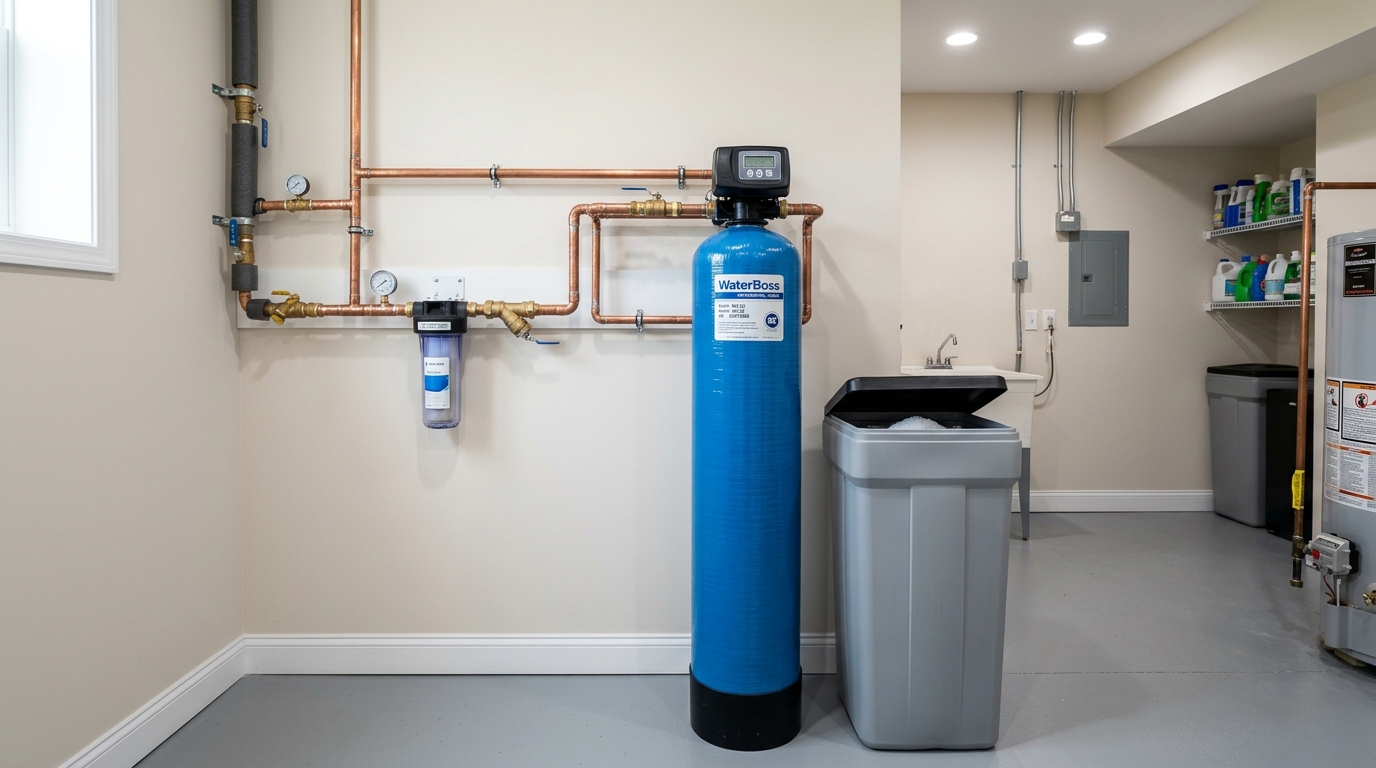
Your soap stopped lathering, the glasses came out of the dishwasher spotted, and the brine tank looks completely full of salt. That combination almost always means a water softener salt bridge. In Germantown, MD we find them constantly in July, because the crust that causes the problem is built by humidity. The salt looks fine from above, but a hard shell is spanning the tank with nothing but air underneath it, so the softener is regenerating with water instead of brine. This guide explains how a softener salt bridge forms, how to confirm you have one, and how to break it without cracking the tank.
How a Water Softener Actually Works
Softening is an ion exchange process. The mineral tank is packed with small resin beads that start out loaded with sodium ions. As hard water passes through, calcium and magnesium in the water trade places with that sodium, sticking to the resin and leaving the water soft.
The resin fills up. To reset it, the control valve draws a concentrated salt solution from the brine tank and pushes it back through the resin bed. The flood of sodium ions displaces the calcium and magnesium, which rinse to the drain. That cycle is regeneration, and it only works if the brine is genuinely saturated.
What a Water Softener Salt Bridge Is
Salt pellets in the brine tank are supposed to sit in water and dissolve from the bottom up. A salt bridge is a hardened arch of fused salt that spans from one tank wall to the other, with a void of air beneath it.
The water underneath cannot reach the salt above. Regeneration then draws weak brine or plain water through the resin, which does almost nothing to strip the hardness minerals off the beads. The resin stays saturated, hard water passes straight through, and the tank still looks full because the bridge is holding the entire salt load off the water.
Why a Softener Salt Bridge Forms in a Maryland July
Salt is hygroscopic, meaning it pulls moisture out of the surrounding air. In a humid basement, garage or utility closet, the surface of each pellet picks up a film of moisture, the pellets fuse at their contact points, and as conditions swing the dissolved salt recrystallizes into a solid mass.
Summer humidity is the single biggest driver we see. A few other conditions stack on top of it:
- Overfilling the tank, which adds weight and compresses the pellets into each other.
- Using rock salt or fine crystals with high insoluble content instead of high-purity pellets.
- Low household water use, so the unit regenerates rarely and the salt sits undisturbed for weeks.
- A large temperature swing in the space, which drives repeated dissolving and recrystallizing.
Salt Bridge or Salt Mushing?
These two get confused constantly, and the fix is different for each.
A water softener salt bridge is a crust above an air gap, and you break it from the top. Mushing is the opposite problem: dissolved salt recrystallizes as a sludge at the bottom of the tank, packing around the brine well and blocking the draw. A mushed tank has to be emptied and cleaned out rather than broken up.
If you push a broom handle down and it stops on something hard partway, you have a bridge. If it sinks into a dense paste at the bottom, you have mushing.
A Germantown Scenario
Picture a homeowner in Germantown who notices that the shower feels slippery in a different way, the kettle has scale again, and there is white film on the drinking glasses. A look at the softener shows the brine tank still full to the same line it sat at weeks earlier.
That last detail is the giveaway. Salt that never goes down is salt that never touched water. In a case like this, the unit has likely been running regeneration cycles on plain water for weeks, which is classic water softener salt bridge behavior and explains why hardness tends to return gradually rather than all at once.
How to Break a Water Softener Salt Bridge Safely
- Put the softener in bypass at the control valve so the house is not drawing through the unit while you work.
- Take a long wooden broom handle, not a metal bar, and push straight down in several spots. Keep clear of the brine well, which is the plastic tube holding the float assembly.
- When the crust cracks, break it into pieces small enough to sink, and work them down into the water below.
- Pour a few gallons of warm water over the remaining salt to dissolve what is still fused together.
- Scoop out any mushy sludge at the bottom. That material is mostly insolubles and it will not dissolve on its own.
- Return the unit to service and run a manual regeneration, then retest the water the next day.
Never hammer at a bridge with a metal rod or a screwdriver. Brine tanks are thin polyethylene, and a puncture near the bottom means replacing the tank and cleaning up the flood.
How to Keep It From Coming Back
Keep the brine tank no more than about two-thirds full. A shallower salt load is far less likely to arch into a softener salt bridge, and you will actually see the level drop between regenerations, which is your earliest warning.
Buy high-purity salt pellets rather than rock salt. Run a dehumidifier in the room if the space stays damp, and break up the surface with a broom handle each time you add salt. If the softener has not regenerated in a long stretch, check the control valve settings against your actual water hardness. The U.S. Geological Survey’s Water Science School explains where hardness comes from, and the EPA’s drinking water pages cover the quality basics worth understanding first.
When to Call a Plumber
Call Mallick Plumbing & Heating if hard water persists after you have cleared the bridge and regenerated, if the brine tank refills with water and never draws down, or if the softener makes a continuous drain sound. Those symptoms point past the salt to the injector, the brine float or the resin bed itself.
Resin has a finite service life, and once the beads are fouled with iron or broken down, no amount of salt will fix the output. We handle water softener service and can confirm what is actually happening with a hardness test. If you want the underlying numbers before making decisions, start with water testing. Both Penn State Extension and University of Maryland Extension publish guidance on interpreting household water results.
Frequently Asked Questions
How often should I check for a water softener salt bridge?
Look every time you add salt, and push a broom handle down before you pour. In humid months, checking monthly is reasonable even if the tank looks untouched.
Can a water softener salt bridge damage the softener?
Not usually by itself, but the hard water it lets through will scale your water heater, fixtures and appliances the entire time it goes unnoticed.
Is softened water safe to drink?
Softened water exchanges hardness minerals for a small amount of sodium. If anyone in the household is on a sodium-restricted diet, ask your physician, and consider a reverse osmosis system at the kitchen tap.
Why did this never happen in my last house?
Location matters enormously. A softener in a conditioned utility room behaves very differently from one sitting in a damp basement or an unconditioned garage.
Your Next Step
If your salt level has not moved in weeks, check for a bridge before you buy another bag. Then call Mallick Plumbing & Heating to schedule a water softener inspection at your Germantown home. We will test your hardness, check the brine draw and the resin condition, and tell you plainly whether the water softener salt bridge was the whole story or only the symptom.