
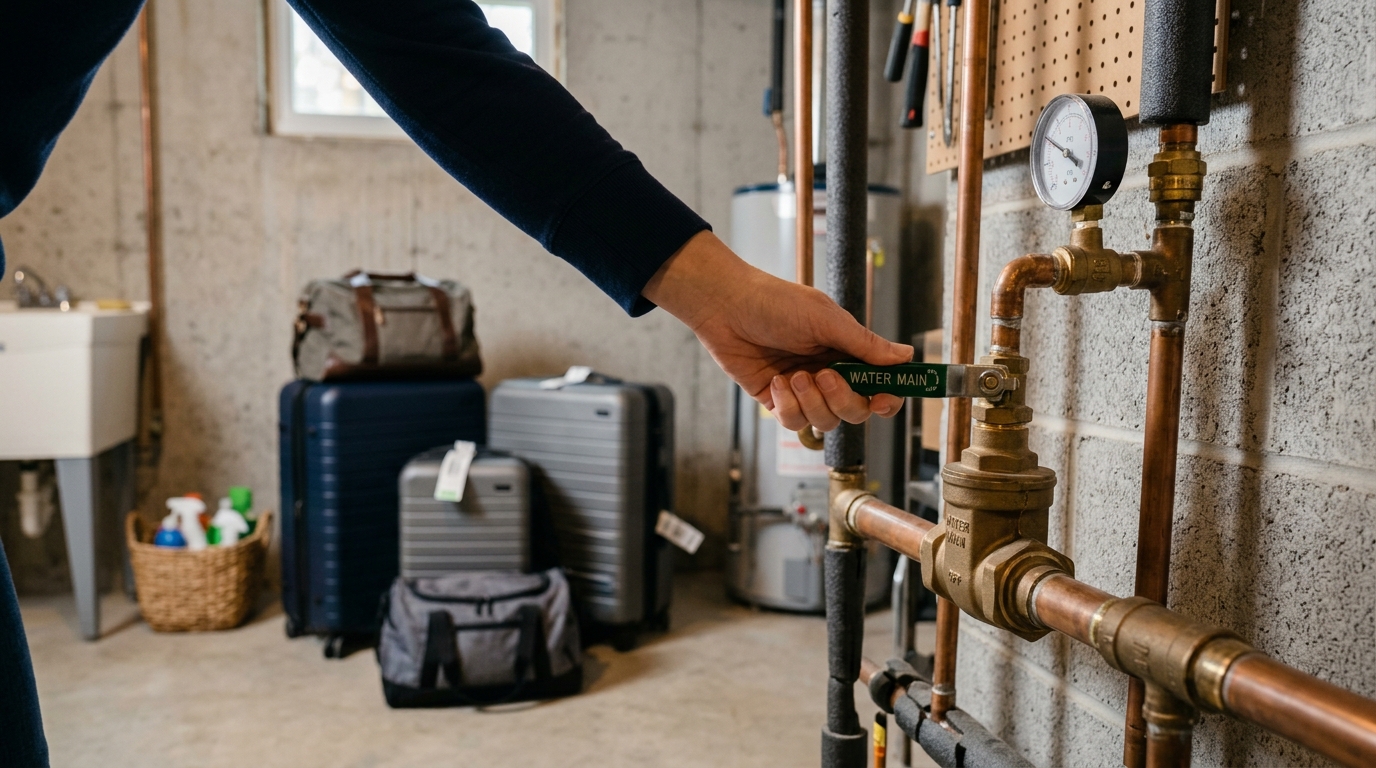
You’ve packed the car, set the timer on the lights, and locked the back door. And then a supply line bursts behind the washing machine while you’re at the beach. By the time the neighbor notices water seeping under the garage door, your hardwood floors are toast. A simple vacation plumbing checklist for Gaithersburg, MD homeowners takes 15 minutes before you leave and is the most basic insurance policy in home ownership. This guide walks through the seven steps Mallick Plumbing & Heating recommends before any trip longer than a weekend.
Why Vacation Is Prime Time for Plumbing Failures
Empty homes don’t experience fewer plumbing failures — they experience worse ones, because nobody’s there to notice. According to the Insurance Information Institute, water damage is one of the most common and costly homeowner insurance claims, and the worst claims are almost always from undetected leaks that ran for days or weeks.
The common Gaithersburg failure modes — a corroded supply line behind a fixture, a slow toilet leak, a sump pump that quits during a storm — are all things you’d notice and stop within minutes if you were home. Gone for a week, the same failures can mean tens of thousands of dollars in damage and a months-long restoration project.
This checklist is what we recommend for any trip of more than 48 hours.
The 7-Point Pre-Vacation Plumbing Checklist
1. Shut Off the Main Water Valve
The single biggest protection is also the simplest. Locate your home’s main water shut-off valve — in most Gaithersburg homes it’s on the front wall of the basement near where the water line enters the foundation — and turn it clockwise until tight. Open the lowest faucet in the house briefly to confirm the flow stops.
If your home has an irrigation system or pool that needs to keep running, you may need to leave the main on. In that case, shut off the individual valves at every fixture you can — washing machine, dishwasher, ice maker, toilets, all sinks. The braided supply lines on these fixtures are the most common burst points.
2. Drain the Lines (Optional for Longer Trips)
For trips longer than two weeks, drain residual water from the lines by opening the lowest faucet in the house with the main off. This prevents stagnant water from sitting and reduces the risk if the main fails.
3. Set the Water Heater to Vacation Mode
Most modern water heaters have a “Vacation” or “Pilot” setting that maintains a minimum temperature without fully heating water. This saves significant energy on longer trips and reduces wear on the unit. On older units without a vacation mode, turn the thermostat down to its lowest setting. Do not turn an electric water heater completely off if you’ll be returning to the home in the cold months — restart issues are common.
4. Test and Set Up the Sump Pump
If your basement has a sump pump, test it before you leave. Pour several gallons of water into the pit and confirm the pump cycles on and removes the water. If you have a battery backup, verify the battery indicator shows full charge. If you don’t have a backup and you’re traveling during Maryland storm season (May through October), seriously consider installing one. A pump that fails during a power outage while you’re away is a flooded basement waiting to happen.
5. Check Toilets, Fixtures, and Visible Pipes
Walk the house and look for any active drips, slow leaks, or signs of moisture. A slow leak you’ve been ignoring for weeks can become a major leak under the slightly different pressure dynamics of an empty house. Run a dye-tablet test on every toilet — drop a few drops of food coloring into the tank, wait 15 minutes, and check the bowl. If the color bled through, replace the flapper before you leave.
6. Empty the Dishwasher and Washing Machine
An empty dishwasher with the door slightly ajar prevents stale water in the trap and lets the seals dry out. Same with the washing machine. Both appliances have rubber seals that can develop slow leaks if pressure sits on them for an extended period with the door closed.
7. Arrange a Friend or Neighbor Check-In
For trips longer than a week, arrange for someone you trust to walk through the house once midway through the trip. Even a five-minute look — basement, kitchen, bathrooms — catches problems before they snowball. Leave them a written note with the location of the main shut-off, the water heater, and an emergency phone number. The American Red Cross recommends this for any extended absence as part of basic home preparedness.
Shut Off the Main Valve — Yes or No?
Most Gaithersburg homeowners ask this. The answer for almost every trip longer than 48 hours is yes, shut the main. The only reasons not to:
- An automatic irrigation system that must keep running
- A pool that needs make-up water
- An automatic ice maker connection to a refrigerator that needs continuous water
If any of those apply, you can either let those systems pause for the trip, or use fixture-level shut-offs at every appliance and bathroom while leaving the main open. The fixture-level approach is more work but protects most of the failure modes.
Water Heater Vacation Mode in Detail
For trips of less than a week, leaving the water heater on saves you nothing meaningful and avoids restart issues. For trips of a week or more, vacation mode (or its equivalent) makes sense. Gas water heaters: turn the dial to “Pilot.” Electric: switch the dedicated breaker off if you’re confident it will restart cleanly, or set the thermostat to its lowest setting. Modern hybrid (heat-pump) water heaters typically have a built-in vacation timer that’s worth using.
Set Up the Sump Pump for While You’re Gone
For Maryland trips in storm season, a sump pump with battery backup and a Wi-Fi water alarm is the difference between a dry homecoming and a destroyed basement. Both can be added to an existing setup in a single Mallick visit. For homes with finished basements, we recommend this combination as standard.
What to Do When You Get Home
Before you unpack, walk the basement, kitchen, and bathrooms. Look for any standing water, damp spots, or unfamiliar smells. Then turn the main back on slowly — a sudden return of pressure can dislodge sediment and stress weak fixtures. Check each fixture once flow returns. Reset the water heater to its normal temperature. If anything looks off, call us before using the affected fixture.
Why Gaithersburg Homeowners Choose Mallick
Mallick Plumbing & Heating handles pre-trip and post-trip plumbing checks for Gaithersburg, Rockville, Germantown, Bethesda, and the rest of Montgomery County, as well as Frederick County. A pre-vacation visit takes under an hour and gives you a documented walkthrough of every shut-off, fixture, and risk point in your home — so the next trip is even easier. For background on what a comprehensive inspection includes, see our piece on annual plumbing inspections in Gaithersburg.
For active emergencies while you’re away, our 24/7 emergency line is staffed by live dispatchers.
Schedule a Pre-Vacation Plumbing Check
If you’re traveling more than a week, a 30-minute pre-trip inspection is the most basic peace of mind you can buy. Schedule a pre-vacation plumbing check with Mallick Plumbing & Heating and leave the house knowing every shut-off is tested and every risk point is documented.