
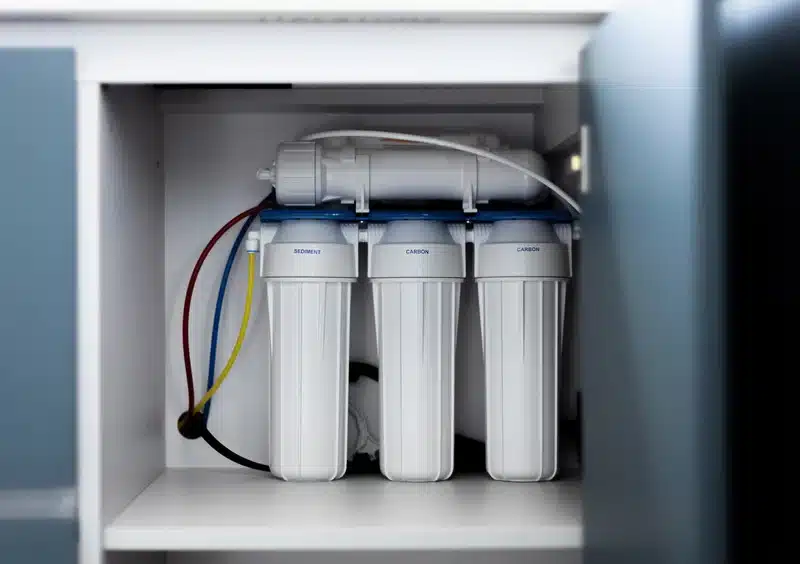
The drinking water faucet used to fill a glass in seconds. Now it dribbles, quits halfway, and the water tastes like the tap again. In almost every case, the reverse osmosis membrane is either blinded by mineral scale or starved of the pressure it needs to work.
A reverse osmosis membrane is not a screen and it does not clog like a filter. It is a rolled sheet of polymer film that separates water molecules from everything dissolved in them. Once you understand that difference, the symptoms at the faucet start making sense.
How a Reverse Osmosis Membrane Actually Makes Drinking Water
Inside the horizontal housing under your sink sits a tightly wound spiral of thin-film composite material. The active layer is a polyamide skin, and it is dense enough that dissolved salts, metals, and nitrates cannot pass through it.
House pressure pushes water against that skin. Pure water molecules squeeze through and collect as permeate, while the rejected minerals stay on the feed side and are washed to the drain as concentrate. That stream to the drain is not waste in the way people assume; it is what keeps the reverse osmosis membrane from burying itself in its own rejected minerals.
Permeate trickles out slowly, so it collects in a small storage tank with an air bladder. When you open the faucet, that bladder squeezes the stored water out. The EPA drinking water program describes the contaminants utilities monitor and report each year, which is a useful starting point for deciding what you want filtered.
Why a Reverse Osmosis Membrane Stops Producing
Four failures cover nearly every slow RO faucet we are called out to look at.
Hardness Scales the Film
Hard water concentrates on the feed side of the membrane as pure water leaves. Calcium and magnesium climb past their solubility limit right at the film surface and precipitate as crystal scale.
That scale is bonded mineral, not loose sediment, so flushing does not remove it. A scaled reverse osmosis membrane produces less and less permeate until the faucet gives you a trickle.
Chlorine Destroys the Polyamide Layer
Polyamide film has almost no tolerance for chlorine. The carbon prefilter exists to strip that disinfectant out before the water reaches the housing.
When the carbon prefilter is past its life, chlorine breaks the polyamide bonds and opens the film. Flow often improves at first, which fools people, but the water now tastes like the tap because the reverse osmosis membrane is no longer rejecting anything.
Sediment and Biofilm Foul the Surface
Silt, rust flakes, and pipe scale blind the inlet side. Bacteria then colonize the damp surfaces and build a slick biofilm, especially in a system that sits unused during a long vacation.
Feed Pressure Falls or the Tank Waterlogs
Reverse osmosis is a pressure-driven process, so anything that drops house pressure cuts production. A pressure reducing valve set low, a clogged sediment prefilter, or a storage tank that has lost its air charge all produce the same complaint. A waterlogged tank feels heavy and empty at the same time.
Signs Your RO System Needs Service
- The faucet runs slowly, then sputters and stops before the glass is full.
- Water tastes flat, metallic, or noticeably like the rest of the house.
- The drain line runs constantly instead of only while the tank fills.
- The storage tank feels heavy when you tip it but delivers very little.
- A test at the faucet shows total dissolved solids close to the raw tap reading.
What This Looks Like in a Potomac Kitchen
Picture a Potomac homeowner who comes back from a summer away. Before the trip the RO faucet filled a pitcher without complaint. Now the same pitcher takes several minutes and the water smells stale.
In a case like this, the likely findings are prefilters left far past their change interval, a storage tank with almost no air charge, and a membrane housing sitting warm with standing water. The fix is typically new sediment and carbon prefilters, sanitized housings, a recharged bladder, and a new element.
Under-Sink RO or Whole-House Filtration?
These two answer different questions, and Potomac homes often end up with both:
- Under-sink reverse osmosis treats drinking and cooking water at one fixture and removes dissolved solids that a cartridge filter cannot touch.
- Whole-house filtration protects every fixture, appliance, and the RO unit itself by removing chlorine, sediment, and taste issues at the main line.
- A softener ahead of the RO cuts hardness before it ever reaches the film, which is the single best way to slow scaling.
Our reverse osmosis service page and our whole-house filtration options lay out how the stages fit together in one plumbing system.
The Maintenance Order That Keeps a Membrane Alive
- Replace the sediment prefilter on schedule so grit never reaches the film.
- Replace the carbon prefilter on schedule so chlorine never reaches the film.
- Check the storage tank air charge with the tank isolated and empty.
- Test the treated water so you know the element is still rejecting solids.
- Sanitize the housings whenever the system is opened or left idle for weeks.
Prefilters exist to protect the element sitting behind them. If yours are overdue, call and schedule a filter change before the membrane takes the damage instead.
Safety Notes and When to Call a Plumber
Shut off the feed valve and relieve pressure before opening any housing, because a pressurized canister can let go when the wrench turns. Sanitizing solutions must be handled by the label directions and flushed completely before anyone drinks the water.
Call a plumber when production stays slow after new prefilters, when you see water under the cabinet, or when the drain line runs without stopping. If anyone in the house has a health condition that depends on water quality, ask your doctor what to filter for and test before you buy equipment.
Frequently Asked Questions
How often should a reverse osmosis membrane be replaced?
It depends on feed water more than time. Hard, chlorinated, or sediment-heavy water shortens element life, while a softener and fresh prefilters extend it. A treated-water test tells you far more than the date on the sticker.
Why does my RO system send water down the drain?
The concentrate stream carries away the minerals the film rejected. Without it, those minerals would build up on the surface and choke production. The EPA WaterSense program has practical guidance on household water use if that flow concerns you.
Does an RO system remove hardness from the whole house?
No. It treats only the fixture it feeds. Hardness in your showers, dishwasher, and water heater needs a softener, which University of Maryland Extension covers in its home water quality material.
Can I install a replacement element myself?
Many homeowners can. The parts that catch people are sanitizing the housing, seating the O-rings correctly, and verifying tank pressure. If the system leaks or underproduces afterward, have it checked.
Your Next Step in Potomac
A slow drinking water faucet is a solvable problem, and the fix depends on which stage failed. Call Mallick Plumbing & Heating to schedule a reverse osmosis membrane inspection in Potomac, and we will test the treated water, check the tank charge, and service the stages in the right order. Start with water testing if you want the numbers first.