
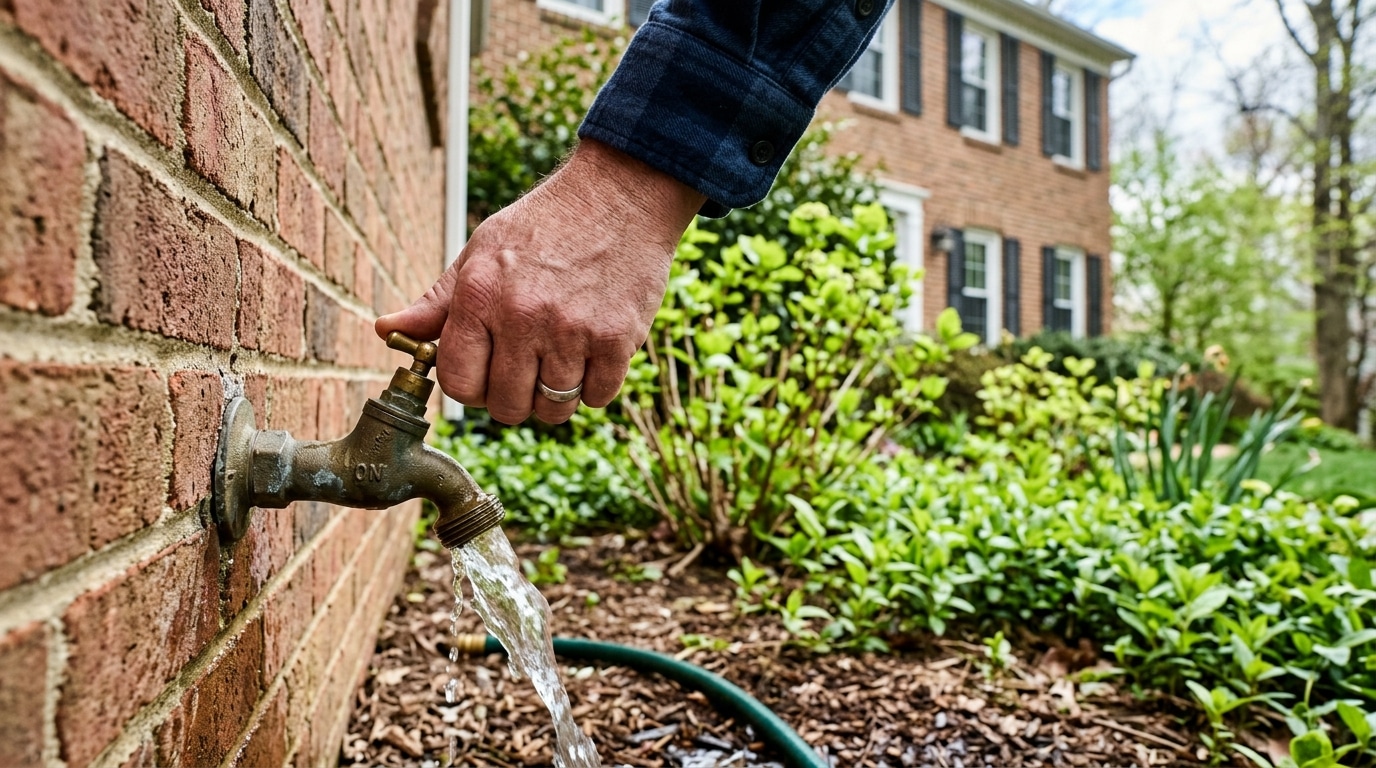
A brass assembly near your irrigation manifold starts pouring water onto the grass in the middle of a July afternoon, and it does not stop. That is a leaking backflow preventer, and in Potomac, MD it is one of the most common midsummer service calls we take. Here is the part that surprises people: on most assemblies, that discharge is the device doing its job. The relief valve opened on purpose to protect your drinking water. What it is telling you is that something upstream has changed. This guide explains how the assembly works, what makes it dump, and why a leaking backflow preventer should never be plugged or capped.
What a Backflow Preventer Is Protecting
Your irrigation system, boiler feed or hose bib connects the potable water in your house to water that has touched soil, fertilizer or chemicals. If pressure in the street main ever drops below the pressure in your piping, that contaminated water can be pulled backward into the supply. A backflow preventer exists to make that physically impossible.
Two designs cover most properties. A double check valve assembly uses two independent spring-loaded check valves in series. A reduced pressure zone assembly, often called an RPZ, adds a differential relief valve between those two checks, and that relief valve is what you see discharging.
Why a Leaking Backflow Preventer Discharges Water
Inside an RPZ, the space between the two check valves is deliberately held at a lower pressure than the incoming supply. A diaphragm senses that difference. As long as the gap stays wide enough, the relief valve stays shut.
When the first check valve stops sealing, pressure in that middle zone climbs toward supply pressure and the differential collapses. The diaphragm reacts by opening the relief valve and dumping the zone to atmosphere, which ensures nothing in that zone can travel back toward the house. A leaking backflow preventer is therefore usually a symptom of a fouled or worn check valve, not a failure of the relief valve itself.
Five Reasons This Happens in July
- Debris on a check seat. Spring irrigation startup pushes pipe scale, sand and bits of thread sealant downstream. One grain holding a check open is enough.
- Thermal expansion. Sun heats the exposed brass and the piping behind it. Water expands, and if a check valve or pressure reducing valve upstream prevents it from pushing back toward the main, pressure climbs until something relieves.
- Street pressure swings. Heavy municipal demand on hot afternoons can drop supply pressure quickly, and the assembly reads that drop as a lost differential.
- Aged rubber. Check discs and relief diaphragms harden over years of chlorinated water and direct sun, then take a permanent set and stop sealing.
- Freeze damage from winter. A hairline crack or a distorted seat from a hard freeze often shows up the first time the system is pressurized for the season.
A Potomac Scenario
Picture a homeowner in Potomac who turns on the irrigation zones during the first hot week of summer. A couple of days later there is a soggy patch around the backflow assembly and a steady stream running out of the bottom of the brass body. Inside the house, the water meter is turning even with every fixture off.
In a case like this, nothing has usually failed catastrophically. The likely cause is startup debris parked on the first check seat, so the middle zone loses its differential and the relief valve does exactly what it was designed to do. The typical repair is a rebuild kit and a thorough flush, not a new assembly.
Why Continuous Discharge Is a Safety Problem
A leaking backflow preventer that runs continuously moves a large volume of water through your meter. Because it discharges to the ground rather than to a drain, nobody notices until the lawn turns to mud.
More to the point, your backflow protection is sitting in its failed position the entire time. That is a safety condition, not a nuisance. The EPA’s drinking water resources explain why cross-connection control matters for a whole neighborhood, not just one property.
The One Thing You Must Never Do
Do not cap, plug or hose-clamp a discharging relief valve. It is the single most dangerous response to a leaking backflow preventer. Blocking the relief port defeats the protection, leaves the middle zone pressurized against a failed check, and turns a visible leak into a hidden cross-connection.
Do not tighten random bolts on the assembly either. The cover is holding a spring-loaded diaphragm, and releasing it without relieving system pressure first can injure you. Shut the downstream isolation valve, then the upstream one, and leave the internals to a plumber.
What a Leaking Backflow Preventer Repair Involves
- Isolate the assembly at both shutoff valves and relieve the pressure through the test cocks.
- Open the check valve chambers and inspect the discs, springs and seats for debris, scoring or hardened rubber.
- Flush the supply line ahead of the device so the same debris does not lodge again within a week.
- Install the manufacturer’s rebuild kit for that model and size rather than mixing generic parts.
- Check for a closed system upstream. A pressure reducing valve or a meter check that blocks expansion is a frequent hidden cause.
- Retest the assembly and confirm the differential holds before the system goes back into service.
Ask your water provider what testing documentation they require for your property and how often. Those requirements come from cross-connection control rules that follow model plumbing codes developed by groups such as IAPMO.
When to Call a Plumber
Call Mallick Plumbing & Heating as soon as the discharge is continuous rather than a brief spurt during a pressure change. Call sooner if the assembly is dripping in freezing weather, if you see corrosion or green staining on the brass, or if pressure in the house has changed along with the leak.
Our backflow prevention service covers testing, repair and replacement. If the root cause turns out to be expansion or a pressure problem, our pressure reducing valve work addresses it at the source, and damaged supply piping falls under our water line service. For irrigation practices that reduce strain on the system, the EPA’s WaterSense program and University of Maryland Extension both publish useful regional guidance.
Frequently Asked Questions
Is a leaking backflow preventer an emergency?
Treat it as urgent. Your backflow protection is compromised while it discharges, and the water loss continues every minute until the assembly is isolated or repaired.
Can I shut the water off to stop it?
Yes, closing the isolation valves on either side of the assembly stops the discharge and takes that branch out of service. Leave the rest of the house on and schedule a repair.
Why does mine only leak when the sprinklers run?
That points to a check valve that seals at static pressure but not under flow. Moving water lifts the disc off a seat that debris or wear has already compromised.
Does a backflow preventer need testing every year?
Many water providers require periodic testing on irrigation and commercial assemblies, and the interval is set locally. Contact your provider for the rule that applies to your address.
Your Next Step
A leaking backflow preventer rarely resolves on its own. If brass is dripping in your yard right now, close both isolation valves to stop the water and leave the assembly alone. Then call Mallick Plumbing & Heating to schedule backflow prevention service at your Potomac property. Tell us the make and model stamped on the body if you can read it, and we will bring the correct rebuild kit.