
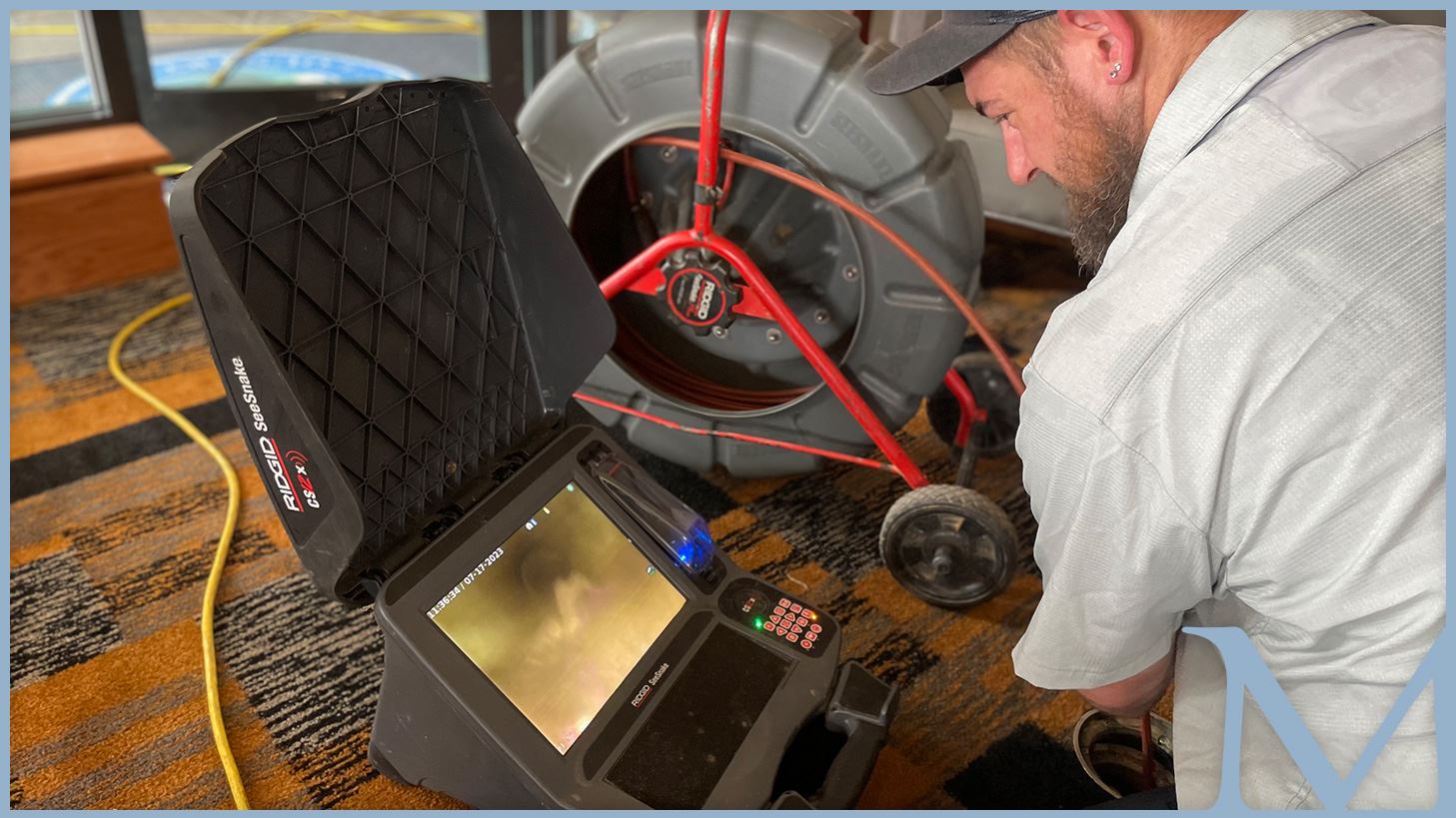
If a plumber clears your main line every spring and the backup returns by fall, the blockage is not the disease. It is the symptom. A sewer line belly in Rockville, MD is a low spot in an otherwise sloped pipe, and it collects waste the way a dip in a gutter collects leaves. Cabling the line scrapes it out for a while, but the sag stays exactly where it is. This guide explains how the sag forms underground, why it keeps refilling, and how we confirm it with a camera before anyone digs.
What a Sewer Line Belly Actually Is
Your building drain is not pressurized. It moves waste by gravity alone, which means it depends entirely on continuous downhill fall from the house to the street. Model plumbing codes maintained by organizations such as IAPMO set a minimum uniform slope for residential drains so that liquid and solids travel at the same speed.
A belly is a section where that fall reverses and then recovers. Picture a shallow U pressed into the middle of a straight pipe. Water still gets through, but not the way the designer intended.
The Mechanism: Why the Sag Traps Solids
Here is the physics that matters. In a properly sloped drain, water moves fast enough to keep paper and solid waste in suspension. Plumbers call this scouring velocity, and it is the whole reason slope is regulated.
When the pipe dips, the water slows and spreads out. Velocity drops, and anything heavier than water settles to the invert, which is the bottom of the pipe. Paper sinks and swells. Grease cools against the pipe wall and hardens. Each flush pushes a little more material into the same low spot, and none of it has the energy to climb the far side.
A sewer line belly therefore fills from the bottom up. Eventually the remaining channel is too small to pass a normal load, and you get a backup at the lowest fixture in the house, usually a basement floor drain or a first floor tub.
What Causes the Pipe to Sag in the First Place
Pipe does not bend on its own. Something underneath it moved, and a sewer line belly is the permanent record of that movement. In Rockville and the surrounding Maryland suburbs, we see a short list of causes over and over:
- Poorly compacted trench backfill, often from an earlier utility repair.
- Bedding washed out by a leaking joint, which erodes the gravel supporting the pipe.
- Shrink and swell cycles in clay rich soils that lift and drop the pipe seasonally.
- Root masses that wedge a joint open and let soil migrate into the line.
- Heavy vehicle loading over a shallow lateral, such as a widened driveway.
- Old clay or cast iron sections that crack and settle at the break.
The Web Soil Survey from the USDA Natural Resources Conservation Service lets you look up the soil series under your own lot. That often explains why one street has repeated lateral problems and the next street does not.
A Rockville Split Level Scenario
Picture a family in a Rockville split level whose laundry tub overflows every time the washing machine drains, but only on the second rinse. Everything else in the house drains fine.
That pattern is a classic clue. A washer dumps a large volume fast, which is exactly the load a sagging line cannot handle. In a case like this, a camera might find standing water well out into the front yard, sitting in a dip where a water service replacement once crossed the sewer. When the trench over a crossing like that settles, the sewer settles with it.
Say cabling has been clearing that spot for several seasons. Once the sewer line belly is located precisely, the repair can become a short dig at one point rather than guesswork across the whole yard.
How We Confirm a Belly Before Anyone Digs
You cannot diagnose a sag from the cleanout. A camera has to go in and show it, and the water itself is the proof. When the lens submerges in a section with no active flow, you are looking at a belly.
Our process on a video pipe inspection call looks like this:
- Clear the line enough to pass a camera safely.
- Run the camera from the cleanout toward the municipal main.
- Note the depth and footage where the lens goes underwater.
- Use a sonde locator at grade to mark the low point on the surface.
- Record the length of standing water and the condition of nearby joints.
That surface marking is what turns a vague backup complaint into a targeted repair. Schedule a camera inspection before you agree to any excavation.
Repair Options: Spot Dig, Lining, or Replacement
A sewer line belly is one of the few sewer defects that pipe lining does not solve on its own. A cured in place liner follows the existing shape, so a lined sag is still a sag. This is where comparing the methods matters.
- Spot excavation: Suited to a sag that is short, shallow, and isolated. The crew re-beds that section on compacted stone and restores grade.
- Pipe bursting: A trenchless method that pulls new pipe along the old path. It can correct minor grade loss but will not fix a deep sag.
- Full replacement of the run: Appropriate when the pipe has multiple sags, collapsed sections, or failing joints throughout.
Our trenchless technology options reduce yard disruption, and our sewer line services page explains how we decide between them. The camera footage drives that choice, not a sales script.
Safety Guidance You Should Not Skip
Sewage carries bacteria, and sewer gas can displace oxygen in an enclosed space. Take backups seriously.
- Keep people and pets out of any area with standing sewage until it is cleaned and disinfected.
- Never enter a sewer trench, manhole, or closed sump pit. These are confined spaces and they can hold oxygen deficient air.
- Stop using water fixtures once the lowest drain begins to back up.
- Wear gloves and eye protection during cleanup, and wash thoroughly afterward.
- Do not pour drain chemicals into a line that is already full. They sit in the sag and stay caustic.
For broader guidance on protecting household water and wastewater, the EPA drinking water program is a reliable starting point.
When to Call a Professional
Call us when backups repeat on a schedule, when more than one fixture gurgles at the same time, or when a high volume appliance like a washer triggers the problem. Those patterns point to a main line defect rather than a fixture clog.
The first thing we check is whether the line holds water with no flow running. That single observation separates a sewer line belly from roots, grease, or a partial collapse, and it decides everything that follows.
Frequently Asked Questions
Can a sewer line belly fix itself?
No. The pipe is resting on settled soil, and soil does not push back up. Drain cleaning buys time, but the low spot remains exactly where it was.
How much standing water counts as a problem?
There is no fixed threshold. What we judge is whether the sag holds enough water to drop solids out of suspension between normal uses.
Will a liner solve it?
A liner restores a cracked or root damaged pipe, but it takes the shape of whatever it lines. A sag needs grade correction, not a new inner wall.
Does homeowners insurance treat this as sudden damage?
Coverage varies by policy and carrier. Review your specific terms with your own insurance agent before assuming anything about a claim.
Next Step for Rockville Homeowners
If your main line backs up on a predictable cycle, stop repeating the same cabling visit and find out what the pipe is actually doing. Call Mallick Plumbing & Heating to schedule a camera inspection of your sewer lateral in Rockville. We will locate and mark any sewer line belly on the surface, show you the footage, and walk you through the repair options that fit your yard.