
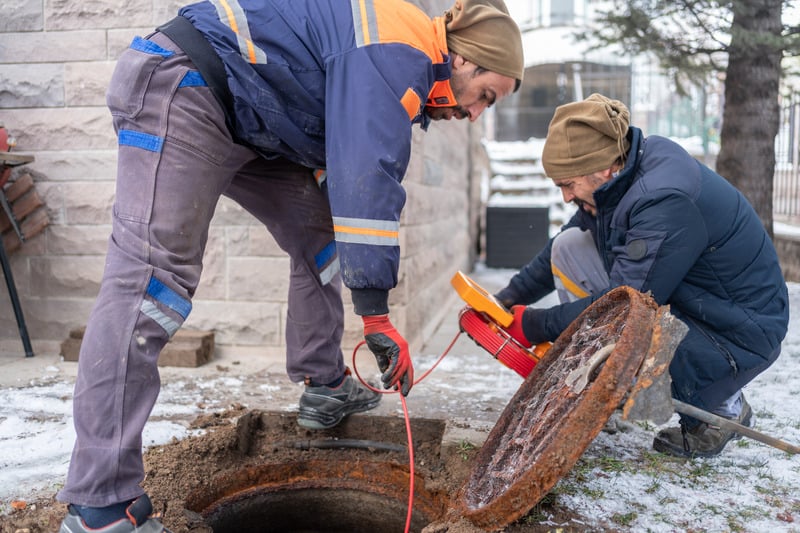
Storm pumps sit idle for weeks and then have to perform perfectly during the worst hour of the year. That is a brutal duty cycle, and it is why storm water pump failure in Columbia, MD so often gets discovered with water already rising. The pump did not break during the storm. It broke quietly weeks earlier, and the storm simply asked it to work. This guide explains what is physically happening inside the wet well, the failure modes we see most, and the checks that catch a dead pump before the rain does.
What a Storm Water Pump Does
A storm water pump moves runoff from a low point that cannot drain by gravity. Common low points include a below grade parking ramp, an exterior stairwell areaway, a loading dock, a window well, and a courtyard drain that sits below the street main.
Runoff collects in a wet well or basin. A float or pressure sensor detects the rising level, the pump starts, and an impeller pushes water up a discharge line to a storm structure at grade. A check valve holds the water column between cycles. Every part in that chain is a candidate for trouble.
The Mechanism: Why Grit Kills Pumps
Here is the difference between a storm pump and a sump pump. A sump pump handles relatively clean groundwater that has filtered through soil. A storm pump handles surface runoff, which carries sand, silt, mulch, road grit, and trash straight off pavement and landscape beds.
That grit is abrasive. Every gallon scours the impeller vanes and the wear ring, which is the close clearance surface that keeps water from recirculating inside the pump. As those clearances open up, the pump moves less water for the same electrical draw. The motor still runs, the basin still fills, and performance quietly collapses.
Grit also settles. Between storms it drops out in the bottom of the wet well and builds a dense layer that buries the inlet screen and fouls the float path. Most storm water pump failure we respond to has been developing across several seasons in exactly this way.
Air Lock, Cavitation, and Other Mechanical Faults
Two more mechanisms explain the storm water pump failure calls where the motor runs but nothing comes out.
An air lock happens when air gets trapped in the pump casing above the impeller. The impeller spins in air, which it cannot move, and the pump never primes. Manufacturers drill a small vent hole in the discharge pipe below the check valve to release that air. If the hole is plugged with silt, the pump can run dry all night.
Cavitation is the other one. When suction pressure drops below the vapor pressure of water, vapor bubbles form at the impeller eye and then collapse violently as pressure recovers. Those collapses pit the metal and sound like gravel rattling inside the housing. Cavitation destroys impellers, and it usually points to a restricted inlet or a basin running too low.
Warning Signs of Storm Water Pump Failure
You can catch most of this without any tools.
- The pump runs longer than it used to for the same rainfall.
- You hear rattling, grinding, or a rising whine rather than a steady hum.
- Water in the basin never drops to the normal off level.
- The breaker trips during or shortly after a storm.
- Silt or mulch is visible around the basin rim or the inlet grate.
- The alarm panel, if there is one, has a light nobody has investigated.
Any of these is a reason to schedule service. Our storm water pump service team can inspect the basin, the float path, and the discharge in one visit.
A Columbia Townhouse Court Scenario
Picture a Columbia townhouse community where a thunderstorm leaves standing water across the shared lower parking court. The pump in the corner basin is energized and humming, but the level is not moving.
In a case like this, pulling the pump might reveal an inlet packed with shredded hardwood mulch from the landscape beds uphill, with a thick layer of sand behind the mulch. If the vent hole in the discharge is also plugged solid, the pump can air lock on the first restart even after the inlet is cleared.
A single townhouse in the same court could have a smaller version of the same problem. Say the stairwell areaway outside a basement door drains to a little pump in a sealed pit, and that float is tangled in leaf litter. Both are the same failure mechanism, just at different scales.
Maintenance That Prevents Storm Water Pump Failure
Storm systems are maintained by clearing what feeds them, not only by servicing the pump.
- Clean the wet well of accumulated grit on a schedule rather than after a flood.
- Keep inlet grates and trench drains clear of leaves, mulch, and trash.
- Verify the discharge vent hole is open every time the pump is pulled.
- Exercise the pump manually between storm seasons so a seized impeller shows up early.
- Test the check valve for backflow, which wastes capacity and causes rapid restarts.
- Confirm the high water alarm sounds and that someone is responsible for answering it.
The USGS Water Science School explains how impervious surfaces increase runoff volume and speed, which is the load your basin has to absorb. The University of Maryland Extension offers practical guidance on managing that runoff upstream of the pump.
Safety Guidance for Wet Wells and Flooded Areas
This is one of the genuinely dangerous corners of plumbing, so read this section carefully.
- Never enter a wet well, vault, or basin. These are confined spaces and can be oxygen deficient. OSHA sets specific entry requirements for a reason.
- Do not step into standing water where pump wiring or a panel may be energized.
- Never drive or walk through flood water in a garage ramp or roadway.
- De-energize and lock out the circuit before anyone touches the pump.
- Keep the basin cover secured and fastened at all times.
Ready.gov has straightforward flood safety guidance worth sharing with residents and tenants before storm season.
When to Call a Professional
Call us at the first sign of storm water pump failure: a pump that runs without lowering the water, grinding or rattling from the basin, or a wet well that has never been cleaned out. Also call when a single storm floods an area that has historically drained fine, because that usually means capacity has quietly degraded.
The first thing we check is whether the impeller is actually moving water or simply spinning. That one test separates a clogged inlet from an air lock, worn clearances, or a failed check valve. Our storm drainage services page covers the systems we maintain.
Frequently Asked Questions
How often should a storm water basin be cleaned?
It depends on how much sediment your site sheds rather than on a fixed calendar. Sites with mulched beds or unpaved areas uphill need attention far more often.
Can I use a regular sump pump instead?
No. Sump pumps are built for clean groundwater and clog quickly on grit and debris. Storm duty calls for a pump rated to pass solids.
What causes storm water pump failure during a power outage?
The pump simply has no power, which is why sites that flood regularly need a backup power plan. Generators and transfer equipment should be tested before storm season.
Does a high water alarm prevent flooding?
It buys you response time, nothing more. The alarm is only useful if someone is assigned to act on it immediately.
Next Step for Columbia Property Owners
If you manage a garage ramp, courtyard, or areaway in Columbia that depends on a pump, do not wait for the next storm to test it. Call Mallick Plumbing & Heating to schedule a storm system inspection. We will clean the basin, verify the float path and vent hole, test the check valve, and tell you exactly what stands between your property and the next storm water pump failure. Our commercial plumbing services page explains the full scope.