
Most expensive plumbing failures don’t start with a flood. They start with a leak too small to see, running for weeks or months behind drywall, under a slab, or inside a wall cavity. By the time the damage shows up, the impact is exponentially higher than catching the leak early. If you’re researching leak detection in Gaithersburg, MD because your water bill jumped, you’ve spotted a stain on the ceiling, or you suspect something’s off but can’t find it, this guide walks through the signs of a hidden leak, the DIY tests you can run yourself, and what professional electronic leak detection looks like.
Why Hidden Leaks Are So Common in Maryland Homes
The mix of housing eras and water conditions across Gaithersburg, Montgomery County, and Frederick County produces a specific set of leak risks:
- Copper pinhole leaks. Maryland’s moderately hard water and the chemistry of WSSC’s treatment can produce pinhole corrosion in copper supply lines, especially in homes built between 1970 and 2000. The leaks are tiny — sometimes a single drop per minute — but they accumulate hundreds of gallons over weeks.
- Failed supply line connectors. The braided steel lines connecting toilets, faucets, dishwashers, and washing machines have a finite life. Slow seepage at the connection point is the most common hidden leak we find.
- Slab leaks. Some Gaithersburg homes have plumbing routed through or under the concrete slab. A leak in those lines is invisible from above until it shows up as a warm spot on the floor or a moisture stain along a baseboard.
- Failing wax rings under toilets. A toilet wax ring that’s failed leaks small amounts of water (and sewage) at every flush. The slow rot of the subfloor below is gradual but devastating.
- Outdoor faucet damage. A frost-cracked hose bib that wasn’t fully replaced after winter can drip inside the wall when used. Often missed because the leak only shows when the spigot is on.
The EPA estimates household leaks account for nearly 1 trillion gallons of wasted water nationwide every year, and many of those leaks go undetected for months because they’re hidden inside walls or under floors.
8 Warning Signs of a Hidden Leak
Watch for these in your Gaithersburg home:
- An unexplained jump in your water bill. If your usage didn’t change but your bill did, you likely have a leak somewhere.
- The sound of running water when nothing is in use. Stand still in a quiet house and listen near walls. A faint hiss or trickle inside a wall is diagnostic.
- Warm spots on a tile or concrete floor. Heated water leaking from a slab line warms the floor above it.
- Damp or discolored spots on walls or ceilings. Even small stains that come and go indicate intermittent moisture.
- A musty smell with no visible source. Wet wood and drywall produce a distinct musty odor before any visible mold appears.
- Mold or mildew at the base of a wall. Mold near floor level often points to a leak above it that’s wicking down.
- Bubbling, cracking, or peeling paint or wallpaper. Moisture behind drywall breaks the bond on the wall finish before anything shows through.
- Cracks in tile grout or popped floor tiles. A slow slab leak can lift or crack tiles directly above the leak point.
DIY Tests You Can Run Yourself
Before calling for professional leak detection, run these tests — they isolate the source for free:
- The water meter test. Find your water meter (usually at the front of the property near the street, or in the basement). Note the reading. Don’t use any water in the house for 1 to 2 hours. Re-read the meter. If it changed, you have a leak somewhere on your side of the meter.
- The toilet dye test. Drop a few drops of food coloring into each toilet tank. Wait 15 minutes without flushing. If the color appears in the bowl, the flapper is leaking — a common, easy fix.
- The fixture audit. Walk the house and check under every sink, behind every toilet, and around every appliance for any damp spot or water stain. Use a flashlight inside the cabinets.
- The cold-tap audit. Cold-only water lines should be at room temperature. Any cold water line that feels warm could indicate a hot-water leak on the other side of a wall warming the cold pipe.
If the meter test shows movement but you can’t find the source, that’s the right moment to call in professional electronic leak detection.
When to Call a Pro for Electronic Leak Detection
Modern leak detection uses several non-invasive technologies that find leaks without tearing up walls or floors:
- Acoustic detection. Highly sensitive listening devices pick up the sound of water escaping under pressure, even through drywall or concrete.
- Thermal imaging. Infrared cameras detect temperature differentials caused by water behind walls, on the underside of subfloors, and in ceilings.
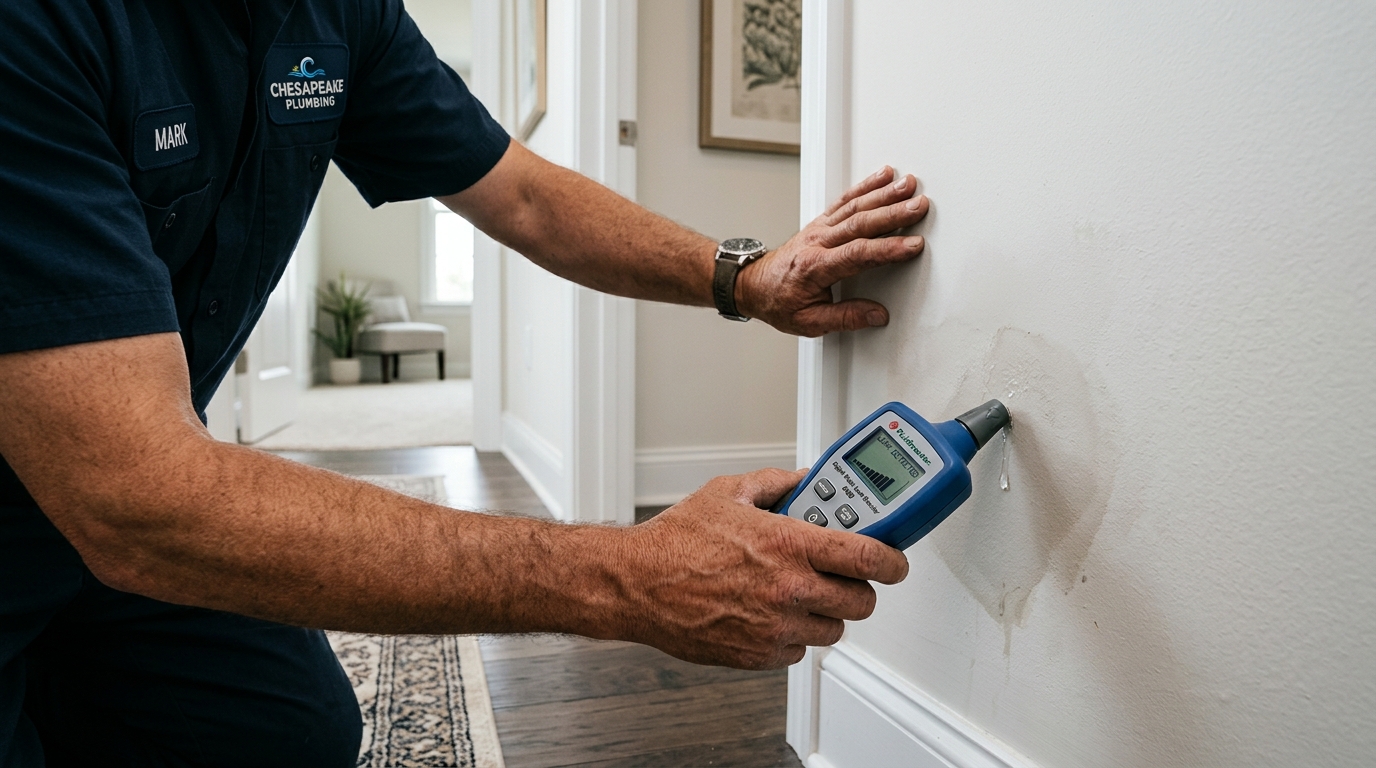
- Moisture meters. Pin and pin-less meters confirm exactly where moisture is present in wall or floor materials.
- Tracer gas. For slab leaks and other tough cases, a small amount of an inert tracer gas is introduced into the affected line. Surface detectors pinpoint exactly where the gas escapes.
The combination identifies the leak point precisely so a single small access cut can reach the affected pipe — instead of opening up an entire wall to investigate.
The Detection Process at Mallick
A Mallick Plumbing & Heating leak detection visit typically follows this sequence:
- Symptom interview. The technician asks where you’ve noticed signs and when, and reviews any recent water-bill data you have.
- Meter test. Confirms the leak exists and gives a rough rate.
- Systematic survey. Acoustic and thermal-imaging sweep of the suspected areas.
- Pinpoint and mark. Once located, the leak is marked with tape or paint and documented with photos.
- Written report and quote. You receive an itemized written quote for the repair, with the option to schedule it the same day in many cases.
Common Repair Scenarios
After detection, the repairs we see most often in Gaithersburg homes:
- Pinhole copper leak. Repaired by cutting out the affected section and replacing with new copper or PEX. Usually a small wall opening.
- Supply line replacement. Failed braided lines at a fixture are swapped in minutes once accessed.
- Toilet wax ring replacement. Pull and reseat the toilet on a new wax ring. Often 60 minutes total.
- Slab leak repair or reroute. Depending on the location, either a targeted opening to repair the pipe in place, or rerouting the line through the ceiling or wall above the slab.
- Pipe relining or replacement. For homes with widespread pinhole issues, a more comprehensive repipe may be the right long-term answer.
Why Gaithersburg Homeowners Choose Mallick for Leak Detection
Mallick Plumbing & Heating handles electronic leak detection and repair across Gaithersburg, Rockville, Germantown, Bethesda, and the rest of Montgomery County, as well as Frederick County. Our technicians use professional acoustic, thermal, and moisture detection equipment and are trained to find leaks without unnecessary demolition. Every detection visit produces a written report with photos and an itemized repair quote. For an active major leak, our 24/7 emergency line dispatches immediately.
For more on the leak detection and broader plumbing services we offer for Maryland homes, visit our leak detection services page. For homeowners on an annual maintenance rhythm, see our piece on annual plumbing inspections in Gaithersburg.
Schedule Electronic Leak Detection in Gaithersburg
The longer a hidden leak runs, the more it impacts to fix. If your water bill is up, you’ve spotted a stain, or you just have the sense something is off, schedule a professional leak survey. Schedule electronic leak detection with Mallick Plumbing & Heating today.