
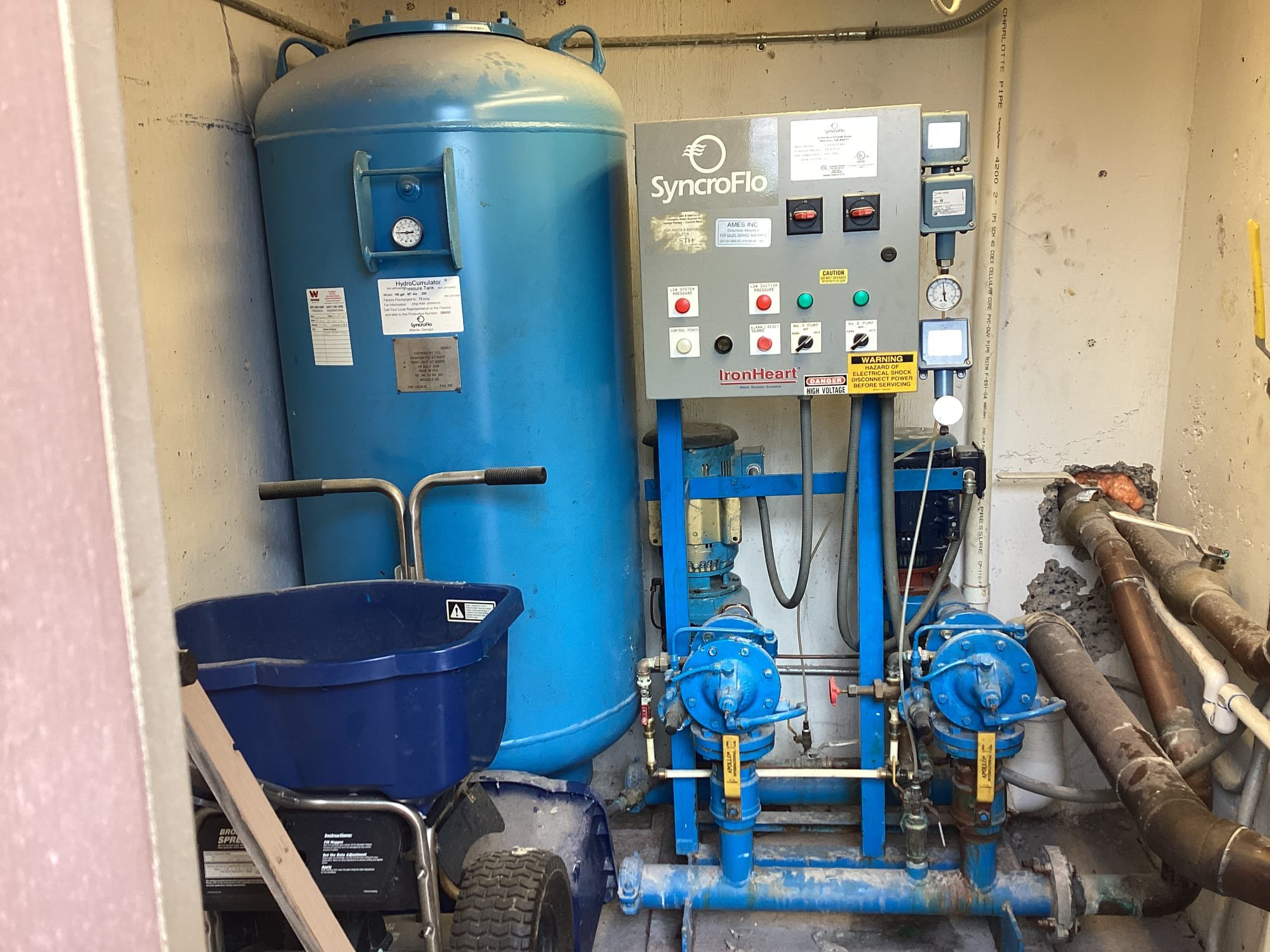
If your well pump snaps on and off every few seconds while a hose is running, you almost certainly have a waterlogged pressure tank. We hear about it most in July, when homes in Poolesville, MD are irrigating gardens and topping off pools, and the well system finally gets pushed hard enough to expose the fault. The tank has lost its air cushion, and without that cushion the pump has nothing to rest on. Left alone, a waterlogged pressure tank will destroy a pressure switch and then the pump motor itself. Here is what is physically happening inside that tank, how to confirm it in your own utility room, and where the work stops being a homeowner job.
What the Pressure Tank Is Actually Doing
A well pump does not run every time you open a faucet. The pressure tank stores usable water between pump runs, and it does that with compressed air.
Inside a modern tank, a butyl rubber bladder or diaphragm separates an air charge on one side from water on the other. When the pump runs, water pushes in and squeezes the air smaller. When you open a tap, that compressed air expands and shoves water back out at usable pressure. The volume you get between the pump’s cut-in and cut-out settings is called drawdown, and drawdown is the entire reason the pump gets to rest.
What a Waterlogged Pressure Tank Is
Waterlogged means the air is gone and the tank has filled with water. Water barely compresses at all, so the tank can no longer store energy. A few cups of flow is enough to drop pressure from cut-out to cut-in, the pressure switch closes, the pump starts, and a few seconds later the switch opens again.
Two failure paths lead there. In an older galvanized tank with no bladder, air and water touch directly, so the air slowly dissolves into the water and leaves with it. Those tanks used an air volume control to replace the charge, and when that part fails the tank waterlogs. In a bladder tank, the rubber tears or the Schrader valve on top leaks, and the pre-charge bleeds away over months.
Why July Exposes a Waterlogged Pressure Tank in Poolesville
Peak summer demand is the stress test. Irrigation, pool filling, garden hoses and extra laundry all pull long, continuous draws rather than the short bursts a household makes in February.
A tank with a weak air charge can still fake its way through short draws, but open a hose bib for a long stretch and the weakness becomes obvious. Shallow groundwater levels also drop through a dry Maryland summer, as the U.S. Geological Survey’s Water Science School explains, so the pump already has more work to do before the tank fails it.
What Rapid Cycling Destroys
The damage from a waterlogged pressure tank is not gradual, and homeowners consistently underrate how quickly it adds up.
- The pressure switch: its contacts arc every time they open and close, and thousands of extra cycles pit them until they eventually weld shut.
- The pump motor: starting current runs far higher than running current, so without run time to shed that heat the windings cook.
- The control box or capacitor: start components on a submersible pump are rated by the manufacturer for a limited number of starts per day, and cycling blows through that allowance in an afternoon.
- The thrust bearing: on a submersible, the bearing loads up at every start, so constant starting wears it far faster than constant running.
- The check valve: repeated slamming hammers the valve seat and the drop pipe hanging below it.
A Poolesville Scenario You Might Recognize
A homeowner waters the vegetable beds on a Saturday morning and notices the sprinkler pulsing, strong then weak then strong again. Inside, the kitchen faucet does the same thing. Down in the utility room, the gauge needle is swinging rapidly between two numbers while the pump clicks on and off in a rhythm you can count.
That pulsing at the sprinkler is the tell. It is drawdown that no longer exists, so every drop of water you use comes straight from the pump instead of from stored pressure.
How to Confirm a Waterlogged Pressure Tank
Work carefully, and shut the breaker to the pump before you do anything beyond looking and listening.
- Watch the gauge with one fixture running, because a healthy system climbs and falls slowly. A waterlogged pressure tank swings between cut-in and cut-out in seconds.
- Tap down the side of the tank with your knuckles. A good tank rings hollow across the top and sounds dull toward the bottom, while a waterlogged one sounds dull everywhere.
- Try to rock the tank, since one that has filled with water is extremely heavy and will not budge.
- With the power off and the tank drained, press the Schrader valve on top. Air means the bladder is intact, and water means it has torn.
- Check the pre-charge with a tire gauge on that same valve while the tank is empty. It should sit slightly below the pump’s cut-in setting, exactly as the tank manufacturer specifies.
What Gets Fixed and What Gets Replaced
A waterlogged pressure tank that simply lost pre-charge through a slow valve leak can often be drained, recharged and returned to service. That is the good outcome, and we check for it first.
A torn bladder cannot be repaired, so that tank gets replaced, and so does a rusted galvanized one. While the system is open, we also confirm the pressure switch contacts, the accuracy of the gauge, and the sizing of the replacement against your household draw. An undersized tank waterlogs less often but still cycles too hard, which puts you back where you started.
Safety and Water Quality
Turn off the pump breaker before draining or charging a tank. Never add air to a tank that still holds system pressure, and never assume a gauge reading is correct without a second gauge to compare it against.
Any time a well system is opened, there is a chance of introducing bacteria. The EPA’s private well resources explain testing and disinfection, and Penn State Extension publishes clear guidance on interpreting well water results. University of Maryland Extension covers the same ground for our region. If the water runs cloudy or gritty after the work, schedule water testing rather than guessing.
Frequently Asked Questions
Can I just add air to a waterlogged pressure tank?
On an older bladderless tank, recharging is a legitimate repair. On a bladder tank, adding air only helps if the bladder is intact and the valve simply leaked. If water comes out of the Schrader valve, the tank needs replacing.
How fast does cycling damage the pump?
Faster than most people expect. A submersible motor that starts constantly can overheat in a single heavy-use weekend, which is why we treat this as urgent rather than routine.
Why does my pressure drop while the shower is running?
Because there is no stored volume left. The pump alone cannot hold steady pressure through a continuous draw, so you feel every cut-in and every cut-out.
Does a bigger tank solve it?
A properly sized tank lengthens each pump run and reduces starts, which is good for the motor. It does not help at all if the bladder is torn, because the tank still cannot hold an air charge.
Your Next Step
A waterlogged pressure tank is one of the few well problems that gets worse by the hour. If your gauge is swinging and the pump is clicking, shut the breaker and stop drawing water until someone looks at it. Call Mallick Plumbing & Heating to schedule well pump and pressure tank service at your Poolesville home. If the pump has already stopped producing water, contact our emergency plumbing team and we will get the system back online.