
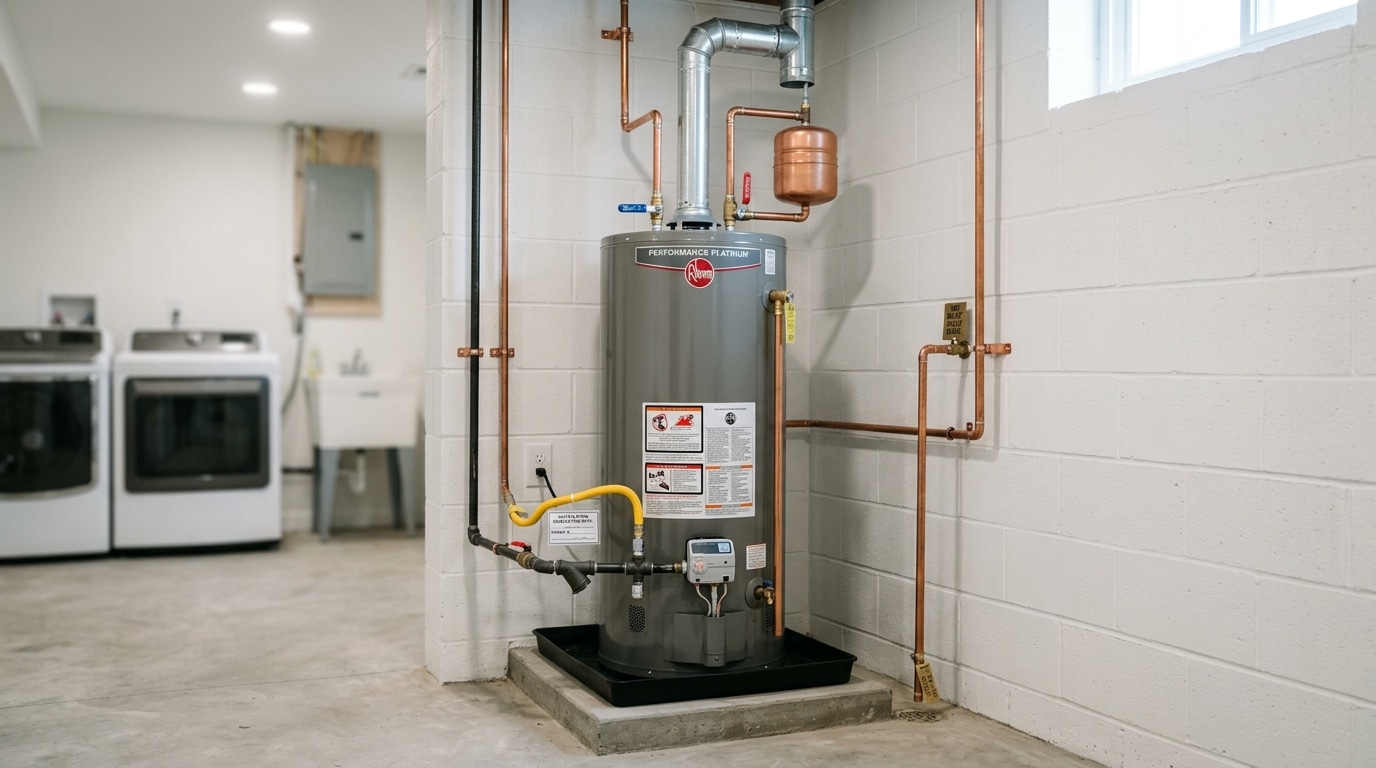
There is a puddle under the water heater, but the tank itself is dry. The water is coming from a small pipe near the top, and it only drips after someone showers. That pattern almost always means the water heater expansion tank has failed and pressure has nowhere to go.
The small blue or silver canister plumbed into the cold line above your heater is not decoration. In a Rockville home with a pressure reducing valve at the meter, the water heater expansion tank is the only thing absorbing the pressure your heater creates every time it fires.
What Thermal Expansion Actually Does to Your Plumbing
Water is essentially incompressible, and it takes up more room when it is hot than when it is cold. Every time your heater warms a full tank, the water inside needs somewhere to put that extra volume.
In an old open system, the extra volume simply pushed back out through the service line toward the street. That escape route is closed in most modern homes, because a pressure reducing valve or a check valve at the meter allows flow in one direction only.
Now the house is a sealed vessel. The heater fires, the water expands, and system pressure climbs fast with nowhere to bleed off. That spike is what cracks toilet fill valves, splits supply hoses, wears faucet cartridges, and stresses the welded seams of the heater itself.
How a Water Heater Expansion Tank Absorbs the Spike
Inside the canister is a flexible butyl rubber bladder with compressed air sealed behind it. Air compresses easily, and that is the whole trick.
When heated water expands, a small amount pushes into the water heater expansion tank and squeezes the air cushion behind the bladder. Pressure rises gently instead of violently. When a fixture opens and demand returns, the cushion pushes that water back into the line.
For this to work, the air charge has to match the static pressure of the house. A tank charged incorrectly is barely better than no tank at all, which is why we always measure incoming pressure before setting one.
Why a Water Heater Expansion Tank Fails
Bladders flex thousands of times a year, and they do not last forever.
The Bladder Ruptures
Once the rubber tears, water floods the air side and the cushion disappears. The unit fills completely and becomes a dead-end piece of pipe. A waterlogged water heater expansion tank feels heavy and cold all the way to the top.
The Air Charge Leaks Away
Air escapes slowly through the Schrader valve or through the rubber itself. The bladder stays intact, but with nothing left to compress, pressure again spikes on every heating cycle.
The Tank Is Mounted or Sized Wrong
A unit too small for the heater it serves absorbs only part of the expansion. Poorly supported tanks also strain the fitting they hang from, and we find them hanging on a single threaded connection more often than we would like.
Signs Rockville Homeowners Call Us About
- Water dripping from the temperature and pressure relief valve discharge pipe.
- Banging or knocking in the walls after the heater finishes a cycle.
- Toilets that run briefly on their own with no one in the bathroom.
- Faucet cartridges and supply hoses that fail repeatedly in the same house.
- An expansion tank that feels heavy, cold, and full when you tap it.
- Water spitting from the Schrader valve when the cap is loosened.
What This Looks Like in a Rockville Basement
Picture a Rockville homeowner with a relief valve that drips every evening and stays dry all day. The heater is only a few years old and the tank shows no rust or leaks.
In a case like this, a tap on the expansion tank may ring solid from top to bottom. If pressing the air valve produces water, that points to a ruptured bladder. High static pressure at the hose bib would also suggest a drifting pressure reducing valve. Replacing the expansion tank alone would mask that second problem, so the fix typically addresses both.
Expansion Tank or Relief Valve: Which One Is the Problem?
These two parts get confused constantly, so here is the difference:
- The expansion tank prevents pressure spikes. It is a cushion, and it works continuously and silently.
- The relief valve reacts to a spike. It is a safety device that opens when temperature or pressure passes its rating.
- A dripping relief valve is a symptom. It usually means expansion has nowhere to go, though a failing valve seat can also drip.
Replacing a relief valve because it drips, while ignoring why it opened, leaves the real fault in place. Our tank water heater page covers how these components are supposed to work together.
How We Diagnose It
- Measure static pressure at an outside hose bib with a gauge.
- Watch how pressure behaves while the heater runs a full cycle.
- Tap the expansion tank and check the Schrader valve for air or water.
- Verify the air charge against measured house pressure with the tank isolated.
- Inspect the pressure reducing valve if the incoming pressure is high.
If your relief valve is dripping, schedule a pressure check before you replace anything. The gauge reading tells us which part actually failed.
Safety Notes and When to Call a Plumber
Never cap, plug, or reroute a relief valve discharge pipe. That valve is the last protection against a heater that overpressurizes, and blocking it is dangerous. The discharge line should terminate where a person will not be scalded.
Call a plumber when the relief valve drips or runs, when you hear banging after hot water use, or when fixtures keep failing. Water heaters combine heat, pressure, and either gas or high-amperage electricity, so installation and safety devices are work for a licensed professional. If the heater itself is near the end of its life, ENERGY STAR lists certified heat pump and gas storage models.
Frequently Asked Questions
How long does a water heater expansion tank last?
Less time than the heater it protects in most cases. Bladders wear with every cycle, and homes with high or fluctuating pressure wear them out faster, which is why we check the tank at every heater service.
Can I test the tank myself?
Yes, in a basic way. Tap the side with a knuckle: the top should sound hollow and the bottom solid. If the whole unit rings solid, or water comes out of the air valve, the bladder is gone.
Does every home need an expansion tank?
Any closed system does. If a pressure reducing valve or check valve sits at the meter, thermal expansion cannot escape, and model plumbing codes published by bodies such as IAPMO call for expansion control on those systems.
Will an expansion tank fix high water pressure?
No. It absorbs expansion caused by heating; it does not lower the pressure arriving from the street. High static pressure is a separate repair, usually at the pressure reducing valve.
Your Next Step in Rockville
A dripping relief valve is your plumbing telling you that pressure has nowhere to go. Call Mallick Plumbing & Heating to schedule a water heater expansion tank inspection in Rockville, and we will measure your pressure, test the tank, and correct the cause instead of the symptom. You can also review our water heater services before the visit.