
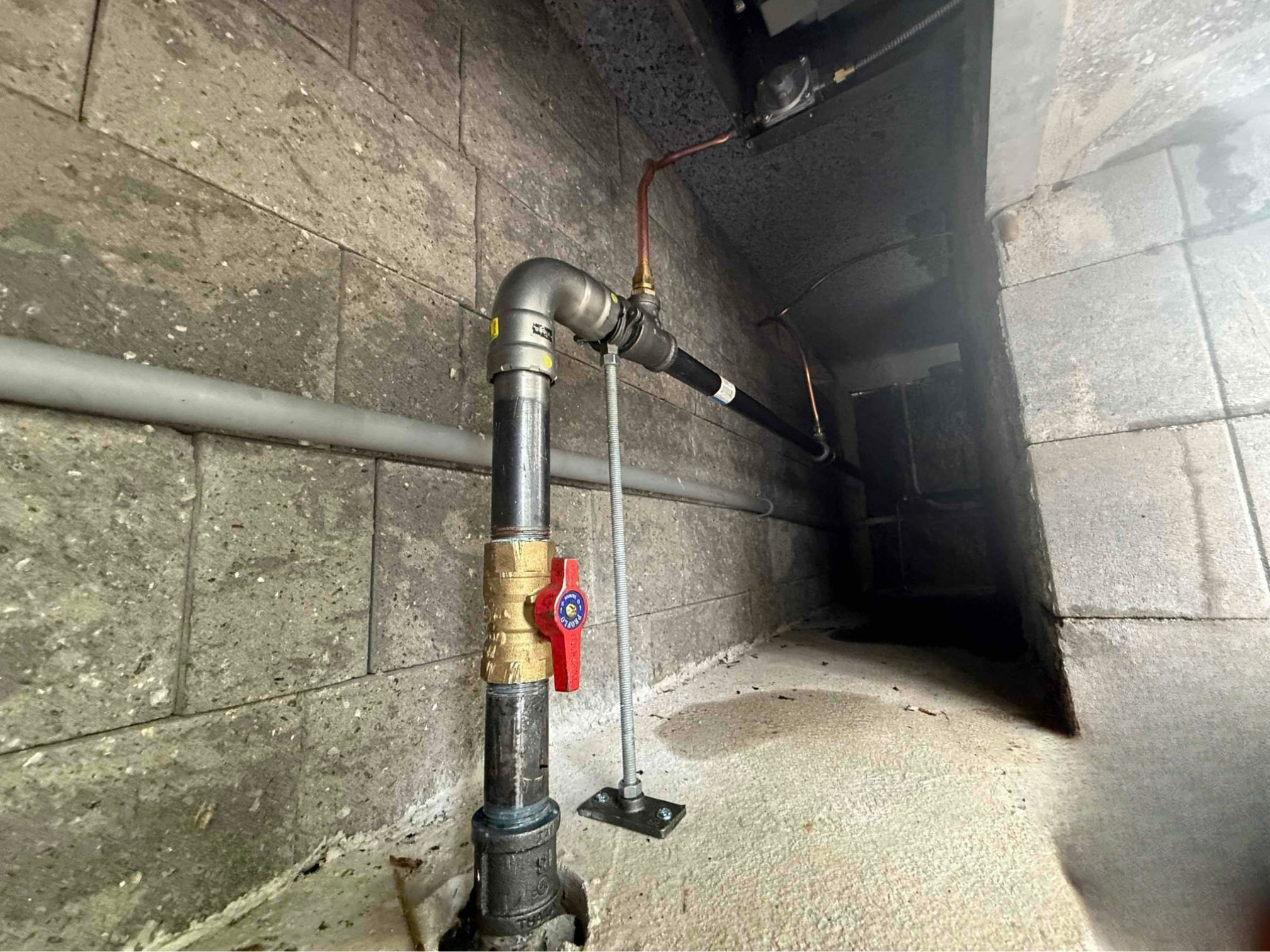
Steel gas pipe buried in Maryland clay does not rust evenly the way a gate hinge does. It corrodes in concentrated spots, and those spots eat through the wall while the rest of the pipe still looks sound. Gas line corrosion in Olney, MD is the reason a line installed decades ago can hold pressure for years and then develop a pinhole in a single wet season. This guide explains the electrochemistry behind that, the parts of your system most at risk, and the exact steps to take if you smell gas.
Where Gas Piping Runs on a Typical Property
Most homes have three distinct zones of gas piping. The utility owns the service line up to the meter. From the meter outward, the piping belongs to you.
That homeowner side usually includes a riser at the wall, black iron or coated steel inside the structure, and often a buried run out to a detached garage, a pool heater, a generator, or a grill connection. Buried sections carry the highest risk, because soil gives gas line corrosion everything the process needs to get started.
The Mechanism: How Gas Line Corrosion Starts in Wet Soil
Corrosion of buried steel is an electrochemical cell, not simple rusting. Moist soil acts as an electrolyte. Small differences along the pipe, in oxygen availability, moisture, soil chemistry, or metal composition, cause one area to behave as an anode and another as a cathode.
Metal ions leave the steel at the anode. That is where material is physically lost, and it produces a pit rather than a uniform thinning. The cathode area is protected and stays intact, which is why a pipe can be pristine along most of its length and perforated at one small spot.
Coated pipe is protected only where the coating is continuous. A nick from a shovel, a scrape during backfill, or a factory defect creates what the trade calls a holiday, a break in the coating. Current concentrates at that small opening, so corrosion accelerates dramatically there. A coated pipe with one bare spot can lose metal faster at that spot than an entirely bare pipe would.
What Makes Gas Line Corrosion Worse Around Olney
Several local conditions push the process along.
- Clay heavy soils hold moisture against the pipe long after a storm.
- Road salt and driveway de-icers raise soil conductivity through the winter.
- Dissimilar metals at a fitting, such as brass against steel, create a galvanic pair.
- Stray direct current from nearby utilities can drive accelerated attack.
- Poor drainage around a foundation keeps the riser wet at the soil interface.
That soil to air interface right at the riser is the most common failure point we find. It stays alternately wet and oxygenated, which is close to ideal conditions for gas line corrosion.
Warning Signs You Can Actually Notice
Natural gas is odorless as it comes out of the ground. Utilities add mercaptan, a sulfur compound, specifically so that a leak smells like rotten eggs at concentrations well below the flammable range. That odorant is your first line of defense.
Beyond the smell, watch for these:
- A hissing or whistling sound near the meter, riser, or buried run.
- Dead or discolored grass in a line over otherwise healthy turf.
- Bubbles rising through standing water or a puddle after rain.
- Dirt or dust blowing up from a small spot in the ground.
- Flaking rust, blistered coating, or scale on the exposed riser.
- Appliance pilot lights that will not stay lit.
Any one of these justifies a call. Our gas line services team can pressure test the system and locate the fault.
An Olney Detached Garage Scenario
Picture a homeowner in Olney who notices a faint rotten egg smell near the back patio that comes and goes. It is strongest after heavy rain and almost absent during dry weeks, which is a pattern worth understanding.
Say the house has a buried line running out to a detached garage heater installed years earlier. In a case like this, a likely finding is coating scraped through where the pipe crosses under a paver walkway, often damaged during hardscape work. Wet soil at that spot completes the circuit and drives the cell, so the pitting concentrates in a few inches of pipe.
During dry weeks the soil may be too resistive to carry the leak to the surface quickly. After rain, saturated ground can push gas sideways until it surfaces near the patio. The fix is typically replacing the damaged run and re-coating the fittings.
Safety Steps If You Smell Gas
This is where guidance stops being general and becomes non negotiable. Do not try to locate or repair a suspected gas leak yourself.
- Leave the building immediately and take everyone with you, including pets.
- Do not switch lights on or off, use a phone indoors, or start a vehicle in an attached garage.
- Do not search for the leak with a flame or a lighter.
- From a safe distance outdoors, call 911 and your gas utility.
- Do not re-enter until the utility or the fire department clears the property.
Incomplete combustion from damaged gas appliances can also produce carbon monoxide. Install listed CO alarms on every level, and if anyone shows symptoms such as headache, nausea, or confusion, get outside and seek care from a physician. The EPA indoor air quality program covers combustion pollutants in more depth, and Ready.gov outlines home emergency planning.
Prevention and Protection Options
You have real choices for limiting gas line corrosion, and they compare differently.
- Sacrificial anode protection. A magnesium or zinc anode wired to the pipe corrodes preferentially and protects the steel. Anodes deplete and need periodic evaluation.
- Factory coated steel with careful backfill. Effective when the installation avoids nicks and uses clean fill instead of rocky spoil.
- Polyethylene gas pipe. Non metallic and immune to electrochemical attack, installed with a tracer wire for locating. It requires approved transition fittings at each end.
- Relocating the run above grade. Sometimes the cleanest answer when a buried line serves an outbuilding.
Our piping services page covers the materials we work with. If you are planning any digging near a buried line, call 811 first and let the utilities mark the property.
Before digging anywhere near a buried line, contact 811. It marks utility-owned lines, but piping past the meter, such as a line to a detached garage, is usually the owner’s responsibility and may not be marked.
When to Call a Professional
Call us when you see rust or blistered coating on the riser, when a buried line serves an outbuilding and has never been inspected, or when an appliance burns with a lazy yellow flame instead of a crisp blue one. We also recommend a pressure test before you sell a home with older buried piping.
The first thing we check is the riser at grade, then the joints and coating condition along any accessible run. A gas leak detection visit uses combustible gas detection equipment rather than guesswork.
Frequently Asked Questions
How long does buried steel gas pipe last?
There is no fixed lifespan. Service life depends on soil conditions, coating integrity, and whether cathodic protection was installed and maintained over the years.
Does gas line corrosion happen inside the house too?
Interior black iron corrodes far more slowly because dry natural gas is not aggressive. Threaded joints in damp crawlspaces and unconditioned basements are the exception worth checking.
Can I paint a rusty riser myself?
Surface paint hides the symptom without addressing the cell driving it. Have the pipe evaluated by a plumber before coating anything.
Is a small gas smell ever acceptable?
No. Treat every gas odor as real, leave the building, and call 911 or your gas utility from outside. There is no safe amount to ignore.
Next Step for Olney Homeowners
If you have buried gas piping on your property, or an exposed riser showing rust, call Mallick Plumbing & Heating and schedule a gas piping inspection in Olney. We will test the system, examine the coating and fittings, and tell you plainly whether gas line corrosion has reached the point of repair or replacement.