
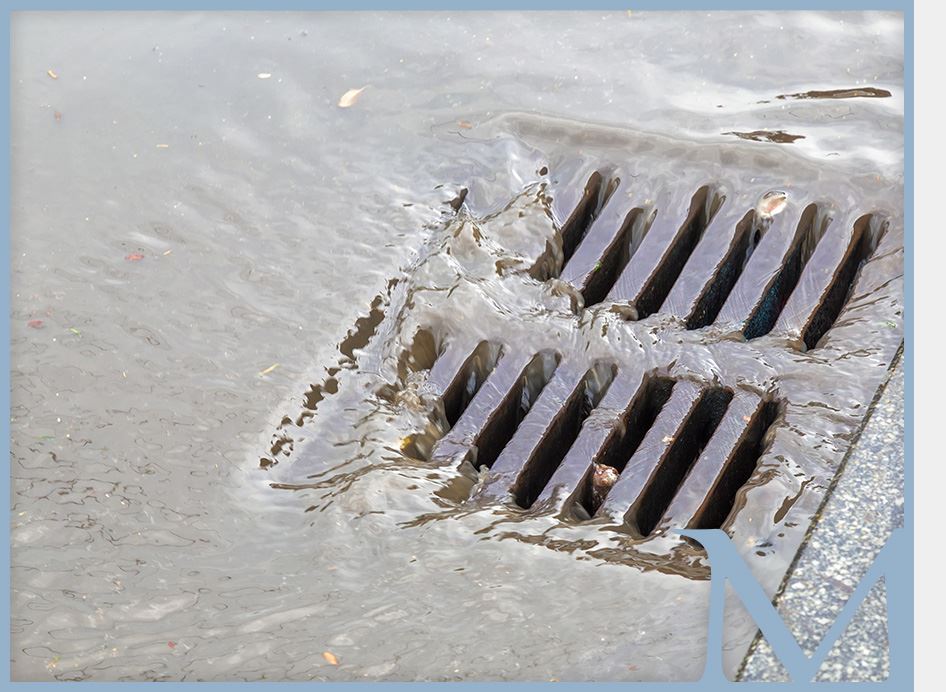
Every July we get calls from property owners watching water rise out of a yard grate instead of draining into it. That is a storm drainage backup, and in Frederick, MD it happens in the same locations year after year. The short answer is that the buried line has filled completely and the water has nowhere to go but back up through the lowest opening. That is a hydraulic condition called surcharging, and it is predictable once you understand it. Below we explain what makes a storm drainage backup happen, the parts that fail first, and the maintenance that keeps the same corner of your property from flooding every summer.
How a Storm Drainage System Is Supposed to Work
Storm drainage is a gravity system. Rain lands on roofs, driveways and lawns, runs to the low points, and enters through yard inlets, trench drains and downspout leaders. From there it flows through buried pipe to a catch basin, then out to a municipal storm sewer, a swale, or a daylight outfall at the edge of the property.
A catch basin is not just a box. It has a sump below the outlet pipe, and that sump is designed to collect sediment so the sediment does not travel into the line. Where gravity cannot do the job, such as a below-grade stairwell or a loading dock, a storm water pump lifts the water instead.
What a Storm Drainage Backup Really Is
Every buried line has a capacity, expressed as the flow it can carry at a given slope. Feed it more water than that and the pipe fills edge to edge. Once it is full, pressure rises and the water level inside the system climbs above the pipe itself.
Plumbers call that level the hydraulic grade line. When it rises above the rim of a grate, water reverses and comes out. That reversal is the storm drainage backup you are watching. Nothing is necessarily broken at that moment. The system is simply being asked to carry more than it can.
The Four Things That Push a System Over the Edge
- Rainfall intensity. Maryland summer storms are convective, meaning they drop a lot of rain in a short window. A line that handles an all-day soaker can surcharge within minutes under a thunderstorm cell.
- Sediment in the pipe. Grass clippings, mulch, pollen and washed silt settle in the flat runs. Capacity falls much faster than the loss of diameter suggests, because both the open area and the flow efficiency drop together.
- Root intrusion. Roots find the joints in older clay and corrugated pipe, then form a mat that catches debris. Summer is peak growing season, so a line that passed inspection in March can be restricted by July.
- Structural damage. Corrugated plastic pipe crushes under vehicle loads and separates when the trench settles. Once the invert deforms, sediment collects at the low spot permanently.
Why Frederick Sees So Many of These
Two local factors compound the problem. Heavy clay content in much of the soil around Frederick sheds water rather than absorbing it, so more rain arrives at the inlets as surface runoff. You can look up the drainage characteristics of your own parcel through Web Soil Survey, which maps soil types nationwide.
The second factor is infill and redevelopment. Added roof area and paving on a lot send more water to a drainage system that was sized for the older, smaller footprint. The U.S. Geological Survey’s Water Science School explains how impervious surfaces change runoff volume and timing.
A Frederick Scenario You May Recognize
A homeowner has a basement door at the bottom of an exterior stairwell, with a small area drain in the floor of that well. Most of the year it works fine. Then a July thunderstorm parks overhead, and within a few minutes the drain gurgles, stops taking water, and the stairwell fills toward the threshold.
The drain did not break. The buried line it feeds is surcharged from the roof leaders upstream, and that stairwell is the lowest opening in the system. This is the classic residential storm drainage backup, and it is also the one that puts water inside the house.
How to Prevent a Storm Drainage Backup
- Clean the catch basin sumps at least twice a year, and again after any storm that moves a lot of mulch. That is exactly what the sump is there for.
- Clear grates and inlet screens before storm season. A grate half covered with leaves loses most of its intake capacity.
- Jet the buried lines on a schedule rather than waiting for a flood. Jetting scours settled silt that a snake simply pushes past.
- Run a camera through the line when backups repeat in the same place. A video inspection separates a sediment problem from a crushed pipe.
- Extend downspout leaders away from the foundation, and keep them off the sanitary sewer entirely.
- Test any storm water pump before summer. Fill the basin with a hose, confirm it starts, and check that the discharge actually reaches daylight.
Safety During a Storm Drainage Backup
Do not lift a grate while water is flowing through it. A surcharged line can pull hard enough to take a person down, and you cannot see the opening underneath.
Stay out of flooded stairwells and window wells where electrical circuits may be submerged. Storm water carries whatever was sitting on the pavement, so treat it as contaminated and wash up afterward. Ready.gov has straightforward flood safety guidance worth reading before a storm, not during one. For yard grading and rain garden approaches that reduce the load on buried pipe, University of Maryland Extension publishes practical regional guidance.
When to Call a Plumber
Call us when the same spot floods in every storm, when a grate backs up during moderate rain, when you see sinkholes or soft spots tracing the line, or when a storm water pump fails to start. Any of those points to a defect rather than an unusually large storm.
Mallick Plumbing & Heating handles storm drainage systems and storm water pumps for residential and commercial properties, and our video pipe inspection shows exactly where a line is restricted before anyone digs.
Frequently Asked Questions
Is a storm drainage backup the same as a sewer backup?
No. Storm lines carry rainwater and sanitary lines carry waste. If what comes up a floor drain smells like sewage, that is a sanitary sewer problem and needs a different response.
Can I connect my sump pump to the storm drain?
Sometimes, but it depends entirely on local rules and on whether the storm line has spare capacity. Adding a pump discharge to an already marginal line can be what tips it into backing up.
Why does it only flood during short, heavy storms?
Because intensity matters more than total rainfall. A gentle rain spread across a whole day never fills the pipe, while the same total arriving in a single cloudburst surcharges it.
Does jetting damage older drainage pipe?
Properly controlled jetting is safe for sound pipe. That is one more reason we camera a line first, since a cracked or separated section needs repair rather than cleaning.
Your Next Step
If a storm drainage backup keeps hitting the same corner of your property, the cause is almost always findable. Call Mallick Plumbing & Heating to schedule a storm drainage inspection at your Frederick property before the next round of thunderstorms. Ask for a camera run on the buried line and a check of the catch basin sumps so you know whether you are dealing with sediment, roots or a broken pipe.